


Page 19 - AIH-2-2
P. 19
Artificial Intelligence in Health                                          Machine learning in arthroplasty


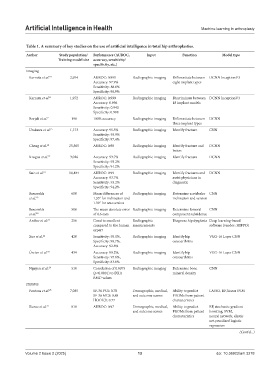
            Table 1. A summary of key studies on the use of artificial intelligence in total hip arthroplasties.
            Author        Study population/  Performance (AUROC,   Input       Function         Model type
                          Training model size  accuracy, sensitivity/
                                         specificity, etc.)
            Imaging
             Karnuta et al. 10  2,954    AUROC: 0.991    Radiographic imaging  Differentiate between  DCNN InceptionV3
                                         Accuracy: 97.9%                  eight implant types
                                         Sensitivity: 88.6%
                                         Specificity: 98.9%
             Karnuta et al. 11  1,972    AUROC: 0.999    Radiographic imaging  Discriminate between  DCNN InceptionV3
                                         Accuracy: 0.996                  18 implant models
                                         Sensitivity: 0.943
                                         Specificity: 0.998
             Borjali et al. 9  198       100% accuracy   Radiographic imaging  Differentiate between  DCNN
                                                                          three implant types
             Urakawa et al. 15  1,173    Accuracy: 95.5%  Radiographic imaging  Identify fracture  CNN
                                         Sensitivity: 93.9%
                                         Specificity: 97.4%
             Cheng et al. 16  25,505     AUROC: 0.98     Radiographic imaging  Identify fracture and   DCNN
                                                                          lesion
             Krogue et al. 17  3,026     Accuracy: 93.7%  Radiographic imaging  Identify fracture   DCNN
                                         Sensitivity: 93.2%
                                         Specificity: 94.2%
             Sato et al. 18   10,484     AUROC: 0.99     Radiographic imaging  Identify fractures and  DCNN
                                         Accuracy: 93.7%                  assist physicians in
                                         Sensitivity: 93.2%               diagnostic
                                         Specificity: 94.2%
             Rouzrokh          600       Mean differences of   Radiographic imaging  Determine acetabular  CNN
             et al. 19                   1.35° for inclination and        inclination and version
                                         1.39° for anteversion
             Rouzrokh          500       The mean absolute error  Radiographic imaging  Determine femoral   CNN
             et al. 20                   of 0.6 mm                        component subsidence
             Archer et al. 21  256       Good to excellent   Radiographic   Diagnose hip dysplasia Deep learning-based
                                         compared to the human  measurements              software (vendor: HIPPO)
                                         expert
             Xue et al. 22     420       Sensitivity: 95.0%,   Radiographic imaging  Identify hip   VGG-16 Layer CNN
                                         Specificity: 90.7%,              osteoarthritis
                                         Accuracy: 92.8%
             Üreten et al. 23  434       Accuracy: 90.2%,   Radiographic imaging  Identify hip   VGG-16 Layer CNN
                                         Sensitivity: 97.6%,              osteoarthritis
                                         Specificity: 83.0%
             Nguyen et al. 24  510       Correlation of 0.8075   Radiographic imaging  Determine bone   CNN
                                         (p<0.0001) to DXA                mineral density
                                         BMD values
            PROMS
             Fontana et al. 25  7,085    SF-36 PCS: 0.78  Demographic, medical,   Ability to predict   LASSO, RF, linear SVM
                                         SF-36 MCS: 0.88  and outcome scores  PROMs from patient
                                         HOOS Jr: 0.77                    characteristics
             Kunze et al. 27   818       AUROC: 0.97     Demographic, medical,   Ability to predict   RF, stochastic gradient
                                                         and outcome scores  PROMs from patient   boosting, SVM,
                                                                          characteristics  neural network, elastic
                                                                                          net-penalized logistic
                                                                                          regression
                                                                                                       (Cont'd...)


            Volume 2 Issue 2 (2025)                         13                               doi: 10.36922/aih.3278

