


Page 24 - AIH-2-2
P. 24
Artificial Intelligence in Health                                          Machine learning in arthroplasty


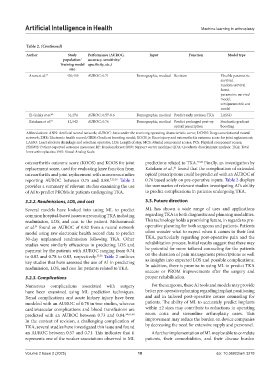
            Table 2. (Continued)
            Author            Study   Performance (AUROC,        Input           Function         Model type
                            population/  accuracy, sensitivity/
                           Training model  specificity, etc.)
                               size
             Aram et al. 59   430,455  AUROC: 0.71         Demographic, medical Revision       Flexible parametric
                                                                                               survival,
                                                                                               random survival
                                                                                               forest,
                                                                                               parametric survival
                                                                                               model,
                                                                                               semiparametric cox
                                                                                               model
             El-Galaly et al. 60  31,274  AUROC: 0.57-0.6  Demographic, medical Predict early revision TKA  LASSO
             Katakam et al. 61  12,542  AUROC: 0.76        Demographic, medical Predict prolonged post-op   Stochastic gradient
                                                                           opioid prescription  boosting
            Abbreviations: ANN: Artificial neural network; AUROC: Area under the receiving operating characteristic curve; DCNN: Deep convolutional neural
            network; EHR: Electronic health record; GBM: Gradient boosting model; KOOS jr: Knee injury and osteoarthritis outcome score for joint replacement;
            LASSO: Least absolute shrinkage and selection operator; LOS: Length of stay; MCS: Mental component scores; PCS: Physical component scores;
            PROMS: Patient-reported outcome measures; RF: Random forest; SMV: Support vector machine; QDA: Quadratic discriminant analysis; TKA: Total
            knee arthroplasties; VAS: Visual Analog Scale.
            osteoarthritis outcome score (KOOS) and KOOS for joint   predictions related to TKA. 59,60  Finally, an investigation by
                                                                           61
            replacement score, used for evaluating knee function from   Katakam et al.,  found that the complication of extended
            osteoarthritis and joint replacement with numerous studies   opioid prescriptions could be predicted with an AUROC of
            reporting AUROC between 0.75 and 0.88. 7,25,26   Table  2   0.76 based solely on pre-operative inputs. Table 2 displays
            provides a summary of relevant studies examining the use   the summaries of relevant studies investigating AI’s ability
            of AI to predict PROMs in patients undergoing TKA.  to predict complications in patients undergoing TKA.

            3.2.2. Readmissions, LOS, and cost                 3.3. Future direction
            Several models have looked into using ML to predict   ML has shown a wide range of uses and applications
            common hospital-based issues surrounding TKA including   regarding TKA in both diagnostic and planning modalities.
            readmission, LOS, and cost to the patient. Mohammadi   This technology holds a promising future, in regards to pre-
            et al.  found an AUROC of 0.82 from a neural network   operative planning for both surgeons and patients. Patients
                54
            model using raw electronic health record data to predict   often wonder what to expect when it comes to their first
            30-day unplanned readmission following TKA. Other   TKA, particularly regarding post-operative pain and the
            studies were similarly efficacious in predicting LOS and   rehabilitation process. Initial results suggest that there may
            payment by the patients with AUROC ranging from 0.74   be potential for more tailored counseling for the patients
            to 0.82 and 0.78 to 0.83, respectively. 55,56  Table 2 outlines   on the duration of pain management prescriptions as well
            key studies that have assessed the use of AI in predicting   as insights into expected LOS and possible complications.
            readmission, LOS, and cost for patients related to TKA.  In addition, there is promise in using ML to predict TKA
                                                               success  or PROM improvements  after the surgery and
            3.2.3. Complications                               proper rehabilitation.
            Numerous complications  associated  with surgery     For the surgeons, these AI tools and models may provide
            have been examined using ML prediction techniques.   better pre-operative planning regarding implant positioning
            Renal complications and acute kidney injury have been   and aid in tailored post-operative course counseling for
            modeled with an AUROC of 0.78 in two studies, whereas   patients. The ability of ML to accurately predict implants
            cardiovascular  complications  and  blood  transfusions  are   within ±2 sizes may contribute to reductions in operating
            predicted with an AUROC between 0.73 and 0.84. 34,57,58    room costs and streamline arthroplasty cases. This
            In the context of revision, a challenging complication of   improvement may reduce the burden on device companies
            TKA, several studies have investigated this issue and found   by decreasing the need for extensive supply and personnel.
            an AUROC between 0.57 and 0.71. This indicates that it   A further implementation of ML may be able to correlate
            represents one of the weaker associations observed in ML   patients, their  comorbidities,  and their  disease  burden


            Volume 2 Issue 2 (2025)                         18                               doi: 10.36922/aih.3278

