


Page 26 - AIH-2-2
P. 26
Artificial Intelligence in Health                                          Machine learning in arthroplasty


            with optimal sensitivity of 95% and specificity of 90% was   4.1.2. Implant positioning
                   63
            reported.  When optimized, their DCNNs could identify   ML does not only efficiently identify shoulder prosthetics
            the implant’s model with an AUROC ranging from 0.86 to   but it can also aid in surgical planning and positioning. In
            1.0, sensitivities between 86% and 100%, and specificities   TSA, following resection of the humeral head along the
            of 100%.  These studies demonstrate that ML in TSA can   anatomical neck, the articular marginal plane becomes
                   63
            contribute to a surgeon’s pre-surgical implant decision-  a crucial area of measurement. This plane refers to the
            making and post-surgical identification when a patient’s   orientation and position of the humeral head implant
            medical records are incomplete.  Table  3 summarizes   relative to the humeral shaft. 67,68  This value is manually
            key studies that have explored the use of AI in implant   calculated but attempts to automate this process have been
            identification related to TSA.                     made with a regression forest-based program to improve

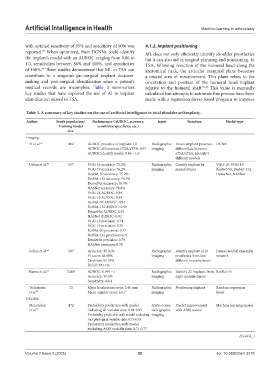
            Table 3. A summary of key studies on the use of artificial intelligence in total shoulder arthroplasty.

            Author       Study population/  Performance (AUROC, accuracy,   Input  Function      Model type
                          Training model   sensitivity/specificity, etc.)
                              size
            Imaging
             Yi et al. 63     482     AUROC presence of implant: 1.0  Radiographic  Detect implant presence,  DCNN
                                      AUROC differentiate rTSA/aTSA: 0.97  imaging  differentiate between
                                      AUROC identify model: 0.86 – 1.0      rTSA/aTSA, identify 5
                                                                            different models
             Urban et al. 64  597     VGG-16 accuracy: 75.2%     Radiographic  Classify implant by   VGG-16, VGG-19,
                                      VGG-19 accuracy: 76.2%     imaging    manufacturer     ResNet-50, ResNet-152,
                                      ResNet-50 accuracy: 75.2%                              DenseNet, NASNet
                                      ResNet-152 accuracy: 74.5%
                                      DenseNet accuracy: 78.9%
                                      NASNet accuracy: 78.8%
                                      VGG-16 AUROC: 0.93
                                      VGG-19 AUROC: 0.93
                                      ResNet-50 AUROC: 0.92
                                      ResNet-152 AUROC: 0.91
                                      DenseNet AUROC: 0.93
                                      NASNet AUROC: 0.93
                                      VGG-16 precision: 0.74
                                      VGG-19 precision: 0.75
                                      ResNet-50 precision: 0.77
                                      ResNet-152 precision: 0.71
                                      DenseNet precision: 0.79
                                      NASNet precision: 0.78
             Sultan et al. 65  597    Accuracy: 85.92%           Radiographic  Identify implant of 16   Dense residual ensemble
                                      F1 score: 84.69%           imaging    prostheses from four   network
                                      Precision: 85.33%                     different manufacturers
                                      Recall: 84.11%
             Kunze et al. 66  3,060   AUROC: 0.994 – 1           Radiographic  Identify 22 implants from  ResNet-34
                                      Accuracy: 97.1%            imaging    eight manufacturers
                                      Sensitivity: 0.8-1
             Tschannen        72      Mean localization error: 2.40 mm  Radiographic  Positioning implant   Random regression
             et al. 69                Mean angular error: 6.51°  imaging                     forest
            PROMS
             McLendon         472     Probability prediction with model   ASES scores,   Predict improvement   Machine learning model
             et al. 72                including all variable data: 0.94-0.95  radiographic   with ASES scores
                                      Probability prediction with model excluding  imaging
                                      morphological variable data: 0.73-0.93
                                      Probability prediction with model
                                      excluding ASES variable data: 0.71-0.77
                                                                                                       (Cont'd...)


            Volume 2 Issue 2 (2025)                         20                               doi: 10.36922/aih.3278

