


Page 27 - AIH-2-2
P. 27
Artificial Intelligence in Health                                          Machine learning in arthroplasty


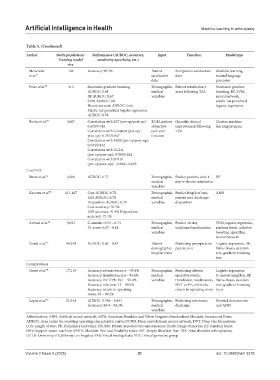
            Table 3. (Continued)
            Author       Study population/  Performance (AUROC, accuracy,   Input  Function      Model type
                          Training model   sensitivity/specificity, etc.)
                              size
             Menendez         186     Accuracy: 98.5%            Patient    Sort patient satisfaction   Machine learning
             et al. 71                                           satisfaction   data         natural language
                                                                 data                        processor
             Polce et al. 70  413     Stochastic gradient boosting    Demographic,  Patient satisfaction 2   Stochastic gradient
                                      AUROC: 0.65                medical    years following TSA  boosting, RF, SVM,
                                      RF AUROC: 0.67             variables                   neural network,
                                      SVM AUROC: 0.8                                         elastic-net penalized
                                      Neural network AUROC: 0.66                             logistic regression
                                      Elastic-net penalized logistic regression
                                      AUROC: 0.74
             Roche et al. 73  3,667   Correlation with SST (pre-op/post-op):   ROM, patient  Quantify clinical   Custom machine
                                      0.630/0.748                subjective   improvement following   learning program
                                      Correlation with Constant (pre-op/  pain and   TSA
                                      post-op): 0.781/0.847      function
                                      Correlation with ASES (pre-op/post-op):
                                      0.694/0.832
                                      Correlation with UCLA
                                      (pre-op/post-op): 0.783/0.852
                                      Correlation with SPADI
                                      (pre-op/post-op): −0.694/−0.825
            Cost/LOS
             Biron et al. 74  4,500   AUROC: 0.77                Demographic,  Predict patients with 1   RF
                                                                 medical    day or shorter admission
                                                                 variables
             Karnuta et al. 75  111,147  Cost AUROC: 0.72        Demographic,  Predict length of stay,   ANN
                                      LOS AUROC: 0.78            medical    patient cost, discharge
                                      Disposition AUROC: 0.79    variables  disposition
                                      Cost accuracy: 76.5%
                                      LOS accuracy: 91.8% Disposition
                                      accuracy: 73.1%
             Arvind et al. 76  9,043  C-statistic: 0.54 – 0.74   Demographic,  Predict 30-day   SVM, logistic regression,
                                      F1-score: 0.07 – 0.18      medical    unplanned readmission  random forest, adaptive
                                                                 variables                   boosting algorithm,
                                                                                             neural network
             Gowd et al. 77  49,354   AUROC: 0.66 – 0.87         Patient    Predicting perioperative  Logistic regression, RF,
                                                                 demographic,  patient cost  Naive-Bayes, decision
                                                                 hospital traits             tree, gradient boosting
                                                                                             tree
            Complications
             Gowd et al. 78  17,119   Accuracy adverse event: 6 – 95.4%  Demographic,  Predicting adverse   Logistic regression,
                                      Accuracy transfusion: 6.4 – 95.6%  medical   operative events,   K-nearest neighbor, RF,
                                      Accuracy DVT/PE: 38.1 – 99.4%  variables  transfusion, readmission,  Naive-Bayes, decision
                                      Accuracy infection: 13 – 99.6%        DVT or PE, infection,   tree, gradient boosting
                                      Accuracy return to operating          return to operating room trees
                                      room: 36 – 99.2%
             Lopez et al. 79  21,544  AUROC: 0.788 – 0.851       Demographic,  Predicting non-home   Boosted decision tree
                                      Accuracy: 89.9 – 90.3%     medical    discharge        and ANN
                                                                 variables
            Abbreviations: ANN: Artificial neural network; ASES: American Shoulder and Elbow Surgeons Standardized Shoulder Assessment Form;
            AUROC: Area under the receiving operating characteristic curve; DCNN: Deep convolutional neural network; DVT: Deep vein thrombosis:
            LOS: Length of stay; PE: Pulmonary embolism; PROMS: Patient-reported outcome measures; ROM: Range of motion; RF: Random forest;
            SMV: Support vector machine; SPADI: Shoulder Pain and Disability Index; SST: Simple Shoulder Test; TSA: Total shoulder arthroplasties;
            UCLA: University of California Los Angeles; VAS: Visual Analog Scale; VGG: Visual geometry group.


            Volume 2 Issue 2 (2025)                         21                               doi: 10.36922/aih.3278

