


Page 74 - AIH-2-2
P. 74
Artificial Intelligence in Health                         Improved liver tumor segmentation with dense networks


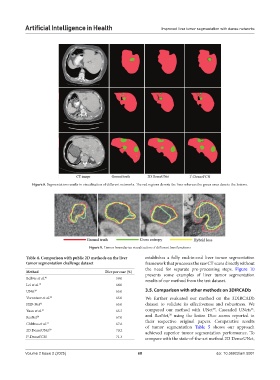
               Figure 8. Segmentation results in visualization of different networks. The red regions denote the liver whereas the green ones denote the lesions.


                                       Figure 9. Tumor boundaries visualization of different loss functions

            Table 4. Comparison with public 2D methods on the liver   establishes a fully end-to-end liver tumor segmentation
            tumor segmentation challenge dataset               framework that processes the raw CT scans directly without
                                                               the need for separate pre-processing steps.  Figure  10
            Method                            Dice per case (%)
                                                               presents some examples of liver tumor segmentation
            Bellver et al. 40                     59.0         results of our method from the test dataset.
            Lei et al. 19                         64.0
            UNet 39                               65.0         3.5. Comparison with other methods on 3DIRCADb
            Vorontsov et al. 22                   65.0         We further evaluated our method on the 3DIRCADb
            FED-Net 42                            65.0         dataset  to  validate  its  effectiveness  and  robustness.  We
                                                                                            39
                                                                                                            16
            Yuan et al. 21                        65.7         compared our method with UNet , Cascaded UNets ,
                                                                         30
            ResNet 30                             67.0         and ResNet,  using the lesion Dice scores reported in
            Chlebus et al. 41                     67.6         their respective original papers. Comparative results
                                                               of tumor segmentation  Table  5 shows our approach
            2D DenseUNet 29                       70.2         achieved superior tumor segmentation performance. To
             2
            I -DenseFCN                           71.3         compare with the state-of-the-art method 2D DenseUNet,
            Volume 2 Issue 2 (2025)                         68                               doi: 10.36922/aih.5001

