


Page 72 - AIH-2-2
P. 72
Artificial Intelligence in Health                         Improved liver tumor segmentation with dense networks


            results summarized in Table 1 show that the Window Clip   3.3.3. Effectiveness of hybrid loss
            method produced a better segmentation result than the No   The effectiveness of the hybrid loss was assessed by comparing
            Window method. This is because the preset CT window   the weighted cross-entropy loss and the hybrid loss. The
            increases the grayscale differences among task-specific   tumor segmentation results of the test dataset are shown in
            tissues in CT images, thereby reducing the learning burden   Table 3. Hybrid loss led to a 1% gain in the Dice per case
            on the segmentation network and eliminating interference   score. Our intuition is that cross-entropy loss, a form of pixel-
            from unrelated tissues. Our integrated CT image pre-  level supervision, lacks understanding of global information,
            processing module achieved the best tumor segmentation   leading to unclear edges in the final segmentation. The
            result, as it was aimed to find optimal CT window settings.  Lovász-Softmax loss is directly oriented toward segmentation

              The visualization of some CT images pre-processed   evaluation metrics and captures global information, but its
            using different techniques is shown in Figure 5. The images   training process is unstable. We utilized a dynamic weighting
            reveal that the lesion regions were more conspicuous   mechanism in the hybrid loss to select the appropriate loss
            against the surrounding tissues when our pre-processing   function  at  different  stages  of  model  training.  To  have  a
            method was used. To have a more quantitative comparison   better visual comprehension of the effect of the hybrid loss,
            of different pre-processing approaches, we illustrated their   we outlined the boundaries of the segmented tumors in
            input-output mapping curves in Figure 6.           Figure 9. The hybrid loss produced finer tumor boundary
                                                               segmentation compared with the cross-entropy loss.
            3.3.2. Effectiveness of I -DenseFCN segmentation
                               2
            network                                              To demonstrate the necessity of the combination of two
                                                               types of loss functions and the superiority of the dynamic
            We investigated the effectiveness of the I -DenseFCN   weights, two more experiments concerning the loss were
                                                2
            segmentation network by comparing it with the 2D   conducted. One is the experiment on the sole Lovász-Softmax
            DenseUNet since the I -DenseFCN network is built upon   loss, the other is a separate two-stage training scheme, where
                              2
            the 2D DenseUNet by introducing the inter-block dense   the network is trained with the weighted cross-entropy
            connections in the decoder. Both of the two networks are   loss in the first stage and then fine-tuned with the Lovász-
            integrated with the proposed CT image pre-processing   Softmax loss in the second stage. The results of the above two
            module for a fair comparison. The training loss curves   supplementary experiments are shown in Table 3. The results
            of the two networks are depicted in  Figure  7. The   show that a joint utilization of the two types of loss functions
            I -DenseFCN network achieved a lower training loss value   achieved better tumor segmentation performance than either
            2
            compared to the 2D DenseUNet. We argue that the skip   of them alone. On the other hand, the design of dynamic
            connections between modules achieve multiscale feature   weights outperformed the two-stage training strategy.
            fusion,  which  helps  to  enhance  the  spatial  information
            of different scales in the output feature maps. This spatial   3.4. Comparison with other methods on LiTS
            information promotes the recognition of small-scale   Since the proposed model is designed based on 2D FCNs
            tumors.  The  Dice  per  case  scores  of  tumors  (Table  2)   due to the limitation of computer resources, its tumor
            indicate that the proposed segmentation network produces   segmentation results were compared against published
            better segmentation results than the 2D DenseUNet,   2D-based methods (Table  4). Most methods employed
            demonstrating the effectiveness of inter-block dense   FCNs but with some variations. Some methods attempted
            connections of the I -DenseFCN network.
                            2
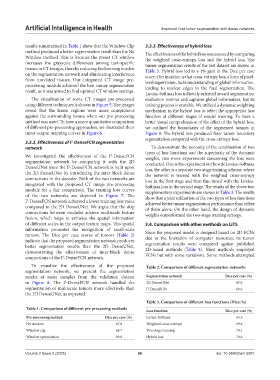
              To visualize the effectiveness of the proposed   Table 2. Comparison of different segmentation networks
            segmentation  network,  we  present  the  segmentation
            results of some samples from the validation dataset   Segmentation network           Dice per case (%)
            in  Figure  8. The I -DenseFCN network handled the   2D DenseUNet                        69.0
                             2
            segmentation of multiscale tumors more effectively than   I -DenseFCN                    69.6
                                                                2
            the 2D DenseUNet, as expected.
                                                               Table 3. Comparison of different loss functions (Dice: %)
            Table 1. Comparison of different pre-processing methods  Loss function               Dice per case (%)

            Pre-processing method             Dice per case (%)  Lovász-Softmax                       65.5
            No window                             67.0         Weighted cross-entropy                 69.6
            Window clip                           68.7         Two-stage training                     70.1
            Window optimization                   69.0         Hybrid loss                            70.6


            Volume 2 Issue 2 (2025)                         66                               doi: 10.36922/aih.5001

