


Page 73 - AIH-2-2
P. 73
Artificial Intelligence in Health                         Improved liver tumor segmentation with dense networks


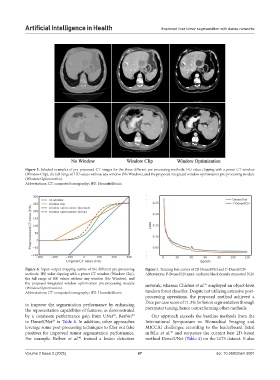
            Figure 5. Selected examples of pre-processed CT images for the three different pre-processing methods: HU value clipping with a preset CT window
            (Window Clip), the full range of HU values without any window (No Window), and the proposed integrated window optimization pre-processing module
            (Window Optimization).
            Abbreviations: CT: computed tomography; HU: Hounsfield unit.


            Figure 6. Input–output mapping curves of the different pre-processing   Figure 7. Training loss curves of 2D DenseUNet and I -DenseFCN
                                                                                                 2
            methods: HU value clipping with a preset CT window (Window Clip),   Abbreviation: I -DenseFCN: intra- and inter-block densely connected FCN.
                                                                        2
            the full range of HU values without any window (No Window), and
            the proposed integrated window optimization pre-processing module   network, whereas Chlebus et al.  employed an object-level
                                                                                        41
            (Window Optimization).
            Abbreviations: CT: computed tomography; HU: Hounsfield unit.  random forest classifier. Despite not utilizing extensive post-
                                                               processing operations, the proposed method achieved a
            to improve the segmentation performance by enhancing   Dice per case score of 71.3% for lesion segmentation through
            the representation capabilities of features, as demonstrated   parameter tuning, hence outperforming other methods.
            by a consistent performance gain from UNet , ResNet    Our approach exceeds the baseline methods from the
                                                 39
                                                         30
            to DenseUNet  in Table 4. In addition, other approaches   International Symposium on Biomedical Imaging and
                       29
            leverage some post-processing techniques to filter out false   MICCAI challenges according to the leaderboard listed
            positives for improved tumor segmentation performance.   in Bilic  et al.  and surpasses the current  best 2D-based
                                                                         36

            For example, Bellver  et al.  trained a lesion detection   method DenseUNet (Table 4) on the LiTS dataset. It also
                                  40
            Volume 2 Issue 2 (2025)                         67                               doi: 10.36922/aih.5001

