


Page 68 - AIH-2-2
P. 68
Artificial Intelligence in Health                         Improved liver tumor segmentation with dense networks


            tumor segmentation in CT images,  named intra-  and   predefined CT window so as to increase the visualization of
            inter-block densely connected FCN (I -DenseFCN). This   certain pathological features relevant to their task. For liver
                                           2
            framework  incorporates  an  adaptive  learning  threshold   tumor segmentation, most previous works convert raw CT
            processing method to enhance the distinguishability of   images into grayscale images using a preset window setting
            tumors from surrounding tissues, thereby improving the   or directly utilize the full range of CT image intensity
                                                                                                   16
            generalization of segmentation capabilities on potential   values without windowing input. Christ et al.  carried out
            samples compared to previous methods. To reduce the   pre-processing  with  a  CT  window  ranging  [−100,  400]
            computational cost associated with the multiscale tumor   HU to exclude irrelevant organs and objects, followed by a
                                                                                                 29
            segmentation  feature,  we  establish  connections  between   histogram equalization operation. Li et al.  truncated the
            feature maps of different levels and propose a decoder   image intensity values of all CT volumes to the range of
            network with inter-block dense connections. Furthermore,   [−200, 250] HU to remove the irrelevant details. Han  set
                                                                                                         30
            we designed a dynamic weighting mechanism to address   the HU value range to [−200, 200], whereas Bi et al.  used
                                                                                                        19
            loss functions at different stages of model training. In   [−160, 240] HU range. These CT image pre-processing
            summary, the threefold contribution of this work is as   settings are subjective and empirical and they vary from
            follows:                                           researcher  to  researcher. It  is  an  open  question  whether
            (i)  We first propose a CT image pre-processing module that   the preset window range is optimal for specific datasets,
               is integrated and jointly trained with the segmentation   models, and for the eventual segmentation performance.
               network, allowing optimal pre-processing settings   Despite the importance of optimal window settings in
               through backpropagation, rather than separate pre-  clinical practice, their impact on the model performance
               processing with an empirically preset CT window.   has been largely overlooked in the liver tumor segmentation
               Our experimental result demonstrates the positive   task. Inspired by the work of Lee  et al.,  we propose a
                                                                                                31
               efficacy of this module on segmentation performance  CT  image  pre-processing  module  that  is  jointly  trained
            (ii)  A decoder module with inter-block dense connections   with the segmentation network to find optimal window
               is built to effectively cope with the challenges posed   settings by learning instead of predefining the value.
               by multiscale  tumors,  resulting  in further  improved   A fully end-to-end segmentation framework is generated
               performance                                     simultaneously. The pre-processing module is composed
            (iii) We attempt to refine the segmentation of tumor   of a 1 × 1 convolutional layer and an activation layer with
               boundaries  in  a  coarse-to-fine  manner.  Specifically,   the sigmoid function. The module structure is shown in
               a hybrid loss function combining the cross-entropy   Figure 2.
               and the Lovász-Softmax loss  with dynamic weights
                                       27
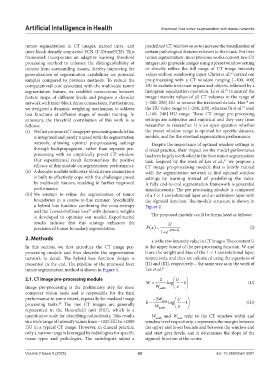
               is developed to optimize our model. Experimental   The proposed module could be formulated as follows:
               results indicate that this strategy enhances the          U
               precision of tumor boundary segmentation.       Fx      Wx b                         (I)
                                                                     1  e
            2. Methods                                           x is the raw intensity value in CT images. The constant U

            In this section, we first introduce the CT image pre-  is the upper bound of the pre-processing function. W and
            processing module and then describe the segmentation   b are the weight and bias of the 1 × 1 convolutional layer,
            network in detail. The hybrid loss function design is   respectively, and they are calculated using the equations of
            presented in the end. The pipeline of the proposed liver   (II) and (III), respectively – the same way as in the work of
            tumor segmentation method is shown in Figure 1.    Lee et al. .
                                                                      31
            2.1. CT image pre-processing module                      2      U
                                                               W       log   1                         (II)
            Image pre-processing is the preliminary step for most   W width
            computer  vision  tasks  and  is responsible  for the  final
            performance to some extent, especially for medical image   2 W level   U
            processing tasks.  The raw CT images are generally   b   W  log     1                  (III)
                          28
            represented in the Hounsfield unit (HU), which is a      width
            quantitative scale for describing radiodensity. This results   W width  and  W  refer to the CT window width and
                                                                            level
            in a wide range of intensity values from −1000 HU to +2000   window level respectively. ε represents the margin between
            HU in a typical CT image. However, in clinical practice,   the upper and lower bounds and between the window end
            only a narrow range is leveraged by radiologists for specific   and start gray levels, and it determines the slope of the
            tissue types and pathologies. The radiologists adjust a   sigmoid function at the center.


            Volume 2 Issue 2 (2025)                         62                               doi: 10.36922/aih.5001

