


Page 9 - AIH-2-2
P. 9
Artificial Intelligence in Health                                Role of LLMs in improving patient experience


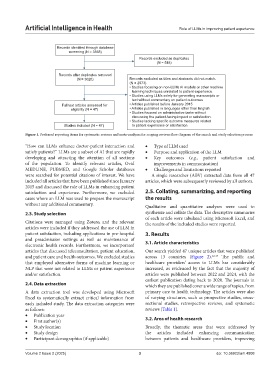
                         Records identified through database
                              screening (N = 3568)
                                                            Records excluded as duplicates
                                                                    (N = 548)

                          Records after duplicates removed
                                  (N = 3020)            Records excluded as titles and abstracts did not match.
                                                        (N = 2973)
                                                        • Studies focusing on non-LLMs AI models or other machine
                                                          learning techniques unrelated to patient experience.
                                                        • Studies using LLMs solely for generating manuscripts or
                                                          text without commentary on patient outcomes
                           Full text articles assessed for  • Articles published before January 2015
                               eligibility (N = 47)     • Articles published in languages other than English
                                                        • Studies focused on administrative tasks without
                                                          discussing the patient-facing impact or satisfaction.
                                                        • Studies lacking specific outcome measures related
                            Studies included (N = 47)     to patient experience or satisfaction
            Figure 1. Preferred reporting items for systematic reviews and meta-analyses for scoping reviews flow diagram of the search and study selection process

            “How can LLMs enhance doctor-patient interaction and   •   Type of LLM used
            satisfy patients?” LLMs are a subset of AI that are rapidly   •   Purpose and application of the LLM
            developing  and  attracting  the  attention  of  all  sections   •   Key outcomes (e.g., patient satisfaction and
            of the population. To identify relevant articles, Ovid   improvements in communication)
            MEDLINE, PUBMED, and Google Scholar databases      •   Challenges and limitations reported
            were searched for potential citations of interest. We have   A single researcher (ABV) extracted data from all 47
            included all articles that have been published since January   articles, which were subsequently reviewed by all authors.
            2015 and discussed the role of LLMs in enhancing patient
            satisfaction and experience. Furthermore, we excluded   2.5. Collating, summarizing, and reporting
            cases where an LLM was used to prepare the manuscript   the results
            without any additional commentary.                 Qualitative and quantitative analyses were used to

            2.3. Study selection                               synthesize and collate the data. The descriptive summaries
                                                               of each article were tabulated using Microsoft Excel, and
            Citations were managed using Zotero, and the relevant   the results of the included studies were reported.
            articles were included if they addressed the use of LLM in
            patient satisfaction, including applications in pre-hospital   3. Results
            and preadmission settings as well as maintenance of
            electronic health records. Furthermore, we incorporated   3.1. Article characteristics
            articles that discussed teleconsultation, patient education,   Our search yielded 47 unique articles that were published
            and patient care and health outcomes. We excluded studies   across 13 countries (Figure  2). 12-17  The public and
            that  employed  alternative  forms  of  machine  learning  or   healthcare providers’ access to LLMs has considerably
            NLP that were not related to LLMs or patient experience   increased, as evidenced by the fact that the majority of
            and/or satisfaction.                               articles were published between 2022 and 2024, with the
                                                               earliest publication dating back to 2020. The journals in
            2.4. Data extraction                               which they are published cover a wide range of topics, from
            A data extraction tool was developed using Microsoft   primary care to health technology. The articles were also
            Excel to systematically extract critical information from   of varying structures, such as prospective studies, cross-
            each included study. The data extraction categories were   sectional studies, retrospective reviews, and systematic
            as follows:                                        reviews (Table 1).
            •   Publication year
            •   First author(s)                                3.2. Area of health research
            •   Study location                                 Broadly, the thematic areas that were addressed by
            •   Study design                                   the  articles  included  enhancing  communication
            •   Participant demographics (if applicable)       between patients and healthcare providers, improving


            Volume 2 Issue 2 (2025)                         3                                doi: 10.36922/aih.4808

