


Page 151 - AIH-2-3
P. 151
Artificial Intelligence in Health                                     Explainable solutions from AI for HSSs


            5.1. Implementing KESs in manufacturing            “covers” several classes of tasks (for example, diagnosis of
            environments                                       diseases regardless of their etiology ). The knowledge base
                                                                                           28
            An example of an environment for producing clinical   is an ever-changing component and should be formed based
            KESs is thematic medical ontological portals, and an   on the created ontology. KES is a special case of applied
            example  of a toolkit  for  modern KES production and   software services on the IACPaaS platform (IACPaaS
            maintenance environments is the Intelligent Adaptive   services). They need the information resources (of the
            Clinical Platform as a Service (IACPaaS) cloud platform.   portal), such as knowledge bases. The set of IACPaaS-portal
                                                               tools for the formation of KES’s information components
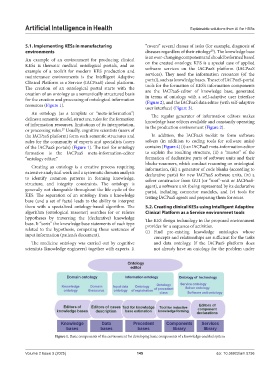
            The creation of an ontological portal starts with the   are the IACPaaS-editor of knowledge base, generated
            creation of an ontology as a semantically structured basis   in terms of ontology with a self-adaptive user interface
            for the creation and processing of ontological information   (Figure 2), and the IACPaaS data editor (with self-adaptive
            resources (Figure 1).
                                                               user interface) (Figure 3).
              An ontology (as a template or “meta-information”)
                                                                 The regular generator of information editors makes
            defines a semantic model, structure, rules for the formation   knowledge base editors available and constantly operating
            of information resources, limitations of its interpretation,   in the production environment (Figure 2).
            or processing rules.  Usually, cognitive scientists (users of
                           27
            the IACPaaS platform) form such semantic structures and   In addition, the IACPaaS toolkit to form software
            rules for the community of experts and specialists (users   solvers (in addition to сoding tools for software units)
            of the IACPaaS portals) (Figure 1). The tool for ontology   contains (Figure 4) (i) an IACPaaS meta-information editor
            formation is the IACPaaS meta-information-editor   to explain the resulting structure, (ii) a “master” of the
            “ontology editor.”                                 formation of declarative parts of software units and their
                                                               blocks-reasoners, which conduct reasoning on ontological
              Creating an ontology is a creative process requiring   information, (iii) a generator of code blanks (according to
            extensive analytical work and a systematic domain analysis   declarative parts) for new IACPaaS software units, (iv) a
            to  identify  common patterns  in forming knowledge,   solver constructor from GUI (or “root”-unit or IACPaaS-
            structure, and integrity constraints. The ontology is   agent), a software unit (being represented by its declarative
            generally not changeable throughout the life cycle of the   parts), including connector modules, and (v)  tools for
            KES. The separation of an ontology from a knowledge   testing IACPaaS agents and preparing them for reuse.
            base (and a set of facts) leads to the ability to interpret
            them with a specialized ontology-based algorithm. The   5.2. Creating clinical KESs using Intelligent Adaptive
            algorithm (ontological  reasoner)  searches  for or  refutes   Clinical Platform as a Service environment tools
            hypotheses by traversing the (declarative) knowledge   The KES design technology in the proposed environment
            base. It “sorts” the knowledge base statements of each type   provides for a sequence of activities.
            related  to  the  hypothesis,  comparing  these  sentences  of   (i)  Find pre-existing knowledge ontologies whose
            input information (patient’s document).               concepts and relationships are sufficient for the tasks
              The medicine ontology was carried out by cognitive   and data ontology. If the IACPaaS platform does
            scientists (knowledge engineers) together with experts. It   not already have an ontology for the problem under


                        Figure 1. Basic components of the environment for developing basic components of a knowledge-enabled system


            Volume 2 Issue 3 (2025)                        145                               doi: 10.36922/aih.5736

