


Page 61 - AIH-2-3
P. 61
Artificial Intelligence in Health                            AI in medical diagnostics: A multi-disease approach


            before  it occurs, demonstrate AI’s  life-saving potential
            by  enabling healthcare  providers  to take preventive
            measures. 18-38  Despite AI’s numerous advantages, it remains
            a complementary tool to healthcare professionals rather
            than a replacement. The human element in healthcare,
            characterized by empathy, ethical judgment, and
            experience, is indispensable. AI’s role in healthcare is to
            support professionals by providing diagnostic suggestions
            and real-time insights. However, ethical concerns
            surrounding data privacy, algorithmic biases, and patient
            consent must be addressed to ensure AI’s responsible and
            effective use in personalized medicine. AI is reshaping the
            healthcare landscape by improving diagnosis, treatment,
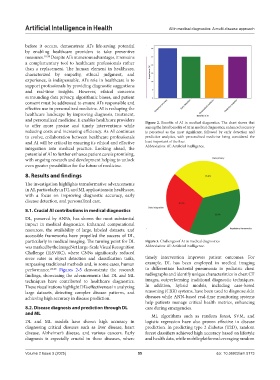
            and personalized medicine. It enables healthcare providers   Figure  2.  Benefits  of  AI  in  medical  diagnostics.  The  chart  shows  that
            to offer more precise and timely interventions while   among the listed benefits of AI in medical diagnostics, enhanced accuracy
            reducing costs and increasing efficiency. As AI continues   is perceived as the most significant, followed by early detection and
            to evolve, collaboration between healthcare professionals   predictive analytics, with personalized medicine being considered the
            and AI will be critical in ensuring its ethical and effective   least important of the four.
            integration into medical practice. Looking ahead, the   Abbreviation: AI: Artificial intelligence.
            potential of AI to further enhance patient care is promising,
            with ongoing research and development helping to unlock
            even greater possibilities for the future of medicine.

            8. Results and findings
            The investigation highlights transformative advancements
            in AI, particularly in DL and ML applications in healthcare,
            with  a  focus  on  improving  diagnostic  accuracy,  early
            disease detection, and personalized care.
            8.1. Crucial AI contributions in medical diagnostics
            DL, powered by ANNs, has shown the most substantial
            impact  in  medical  diagnostics.  Enhanced  computational
            resources,  the  availability  of  large,  labeled  datasets,  and
            accessible frameworks have propelled the success of DL,
            particularly in medical imaging. The turning point for DL   Figure 3. Challenges of AI in medical diagnostics
            was marked by the ImageNet Large-Scale Visual Recognition   Abbreviation: AI: Artificial intelligence.
            Challenge (ILSVRC), where CNNs significantly reduced
            error rates in object detection and classification tasks,   timely intervention improves patient outcomes. For
            surpassing traditional methods and, in some cases, human   example, DL has been employed in medical imaging
            performance. 24-28   Figures  2-5  demonstrate the research   to differentiate bacterial pneumonia in pediatric chest
            findings, showcasing the advancements that DL and ML   radiographs and identify unique characteristics in chest CT
            techniques have contributed to healthcare diagnostics.   images, outperforming traditional diagnostic techniques.
            These visualizations highlight DL’s effectiveness in analyzing   In addition, hybrid models, including case-based
            large datasets, detecting complex disease patterns, and   reasoning (CBR) systems, have been used to diagnose skin
            achieving high accuracy in disease prediction.     diseases while ANN-based real-time monitoring systems
                                                               help patients manage critical health metrics, enhancing
            8.2. Disease diagnosis and prediction through DL   care during emergencies.
            and ML
                                                                 ML  algorithms  such  as  random  forest,  SVM,  and
            DL and ML models have shown high accuracy in       logistic regression have also proven effective in disease
            diagnosing  critical  diseases  such  as  liver  disease,  heart   prediction. In predicting type 2 diabetes (T2D), random
            disease, Alzheimer’s disease, and various cancers. Early   forest classifiers achieved high accuracy based on lifestyle
            diagnosis is especially crucial in these diseases, where   and health data, while mobile platforms leveraging random


            Volume 2 Issue 3 (2025)                         55                               doi: 10.36922/aih.5173

