


Page 147 - AIH-2-4
P. 147
Artificial Intelligence in Health                                 AI-driven personalized learning in residency


            of interactions, and completion rates of educational
            modules. This study also assessed subjective feedback to
            gauge resident satisfaction and perceived benefits of the
            AI-driven learning approach. Data collection extended
            to performance outcomes on simulation-based quizzes,
            aligning engagement metrics with academic progress.

            2.2. AI-driven learning platform
            The  study  utilized  the  edYOU  platform,  an  adaptive,
            AI-based educational system designed to personalize
            learning experiences in graduate medical education. The
            platform’s adaptive content delivery is grounded in key
            principles of adaptive hypermedia, which personalize
            learning pathways based on user modeling.  The platform
                                              15
            also integrates two core components: The personalized
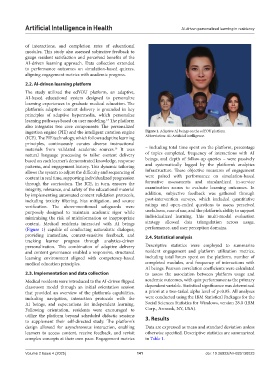
            ingestion engine (PIE) and the intelligent curation engine   Figure 1. Adaptive AI beings on the edYOU platform
            (ICE). The PIE technology, which follows adaptive learning   Abbreviation: AI: Artificial intelligence.
            principles, continuously curates diverse instructional
                                                  16
            materials from validated academic sources.  It uses   – including total time spent on the platform, percentage
            natural language processing to tailor content delivery   of  topics  completed,  frequency  of  interactions  with  AI
            based on each learner’s demonstrated knowledge, response   beings, and depth of follow-up queries – were passively
            patterns, and engagement history. This dynamic tailoring   and systematically logged by the platform’s analytics
            allows the system to adjust the difficulty and sequencing of   infrastructure. These objective measures of engagement
            content in real time, supporting individualized progression   were paired with performance on simulation-based
            through  the  curriculum.  The  ICE,  in turn, ensures  the   formative assessments and standardized in-service
            integrity, relevance, and safety of the educational material   examination scores  to  evaluate  learning outcomes. In
            by implementing automated content validation protocols,   addition, subjective feedback was gathered through
            including toxicity filtering, bias mitigation, and source   post-intervention surveys, which included quantitative
            verification. The  above-mentioned safeguards were   ratings  and open-ended  questions  to assess perceived
            purposely designed to maintain academic rigor while   usefulness, ease of use, and the platform’s ability to support
            minimizing the risk of misinformation or inappropriate   individualized learning. This multi-modal evaluation
            content. Medical residents interacted with AI beings   strategy allowed data triangulation across usage,
            (Figure  1) capable of conducting naturalistic dialogue,   performance, and user perception domains.
            providing  immediate, context-sensitive feedback, and   2.4. Statistical analysis
            tracking learner progress through analytics-driven
            personalization. This combination of adaptive delivery   Descriptive statistics were employed to summarize
            and content governance enabled a responsive, structured   resident engagement and platform utilization metrics,
            learning  environment aligned with competency-based   including total hours spent on the platform, number of
            medical education principles.                      completed modules, and frequency of interactions with
                                                               AI beings. Pearson correlation coefficients were calculated
            2.3. Implementation and data collection            to assess the association between platform usage and
            Medical residents were introduced to the AI-driven flipped   academic outcomes, with quiz performance as the primary
            classroom model through an initial orientation session   dependent variable. Statistical significance was determined
            that provided an overview of the platform’s capabilities,   a priori at a two-tailed alpha level of p<0.05. All analyses
            including navigation, interaction protocols with the   were conducted using the IBM Statistical Packages for the
            AI beings, and expectations for independent learning.   Social Sciences Statistics for Windows, version 28.0 (IBM
            Following  orientation,  residents  were  encouraged  to   Corp., Armonk, NY, USA).
            utilize  the  platform  beyond scheduled  didactic  sessions   3. Results
            to supplement their self-directed study. The platform’s
            design allowed for asynchronous interaction, enabling   Data are expressed as mean and standard deviation unless
            learners  to  access  content,  receive  feedback,  and  revisit   otherwise specified. Descriptive statistics are summarized
            complex concepts at their own pace. Engagement metrics   in Table 1.


            Volume 2 Issue 4 (2025)                        141                          doi: 10.36922/AIH025130023

