


Page 148 - AIH-2-4
P. 148
Artificial Intelligence in Health                                 AI-driven personalized learning in residency


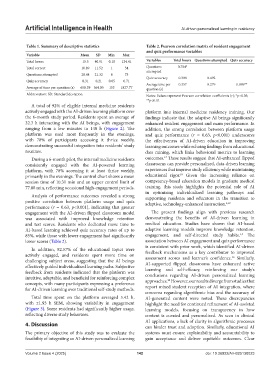
            Table 1. Summary of descriptive statistics         Table 2. Pearson correlation matrix of resident engagement
                                                               and quiz performance variables
            Variable               Mean   SD   Min   Max
            Total hours             15.5  40.91  0.18  124.41  Variables   Total hours Questions attempted Quiz accuracy
            Total correct           10.89  11.52  1   34       Questions     0.784*
                                                               attempted
            Questions attempted     28.44  21.32  6   73
                                                               Quiz accuracy  0.308      0.492
            Quiz accuracy           0.31  0.21  0.05  0.71
                                                               Average time per   0.357  0.279        0.889**
            Average of time per question (s)  658.39 564.05  153  1827.77  question (s)
            Abbreviation: SD: Standard deviation.              Notes: Values represent Pearson correlation coefficients (r); *p<0.05;
                                                               **p<0.01.
              A total of 92% of eligible internal medicine residents
            actively engaged with the AI-driven learning platform over   platform into internal medicine residency training. Our
            the 6-month study period. Residents spent an average of   findings indicate that the adaptive AI beings significantly
            32.3  h interacting with the AI beings, with engagement   enhanced resident engagement and exam performance. In
            ranging from a few minutes to 148  h (Figure  2). The   addition, the strong correlation between platform usage
            platform was used most frequently in the evenings,   and quiz performance (r = 0.63,  p<0.001) underscores
            with 78% of participants accessing it thrice weekly,   the effectiveness of AI-driven education in improving
            demonstrating successful integration into residents’ study   learning outcomes while echoing findings from educational
            routines.                                          data  mining,  which  links  behavioral  metrics  to  learning
                                                                       17
              During a 6-month pilot, the internal medicine residents   outcomes.  These results suggest that AI-enhanced flipped
            consistently engaged with the AI-powered learning   classrooms can provide personalized, data-driven learning
            platform, with 78% accessing it at least thrice weekly,   experiences that improve study efficiency while maintaining
                                                                              18
            primarily in the evenings. The control chart shows a mean   educational rigor.  Given the increasing reliance on
            session time of 10.31 min and an upper control limit of   competency-based education models in graduate medical
            77.08 min, reflecting occasional high-engagement periods.  training, this study highlights the potential role of AI
                                                               in optimizing individualized learning pathways and
              Analysis of performance outcomes revealed a strong
            positive correlation between platform usage and quiz   supporting residents and educators in the transition to
                                                               adaptive, technology-enhanced instruction.
                                                                                                 2,19
            performance (r = 0.63,  p<0.001), indicating that greater
            engagement with the AI-driven flipped classroom model   The present findings align with previous research
            was  associated  with  improved  knowledge  retention   demonstrating the benefits of AI-driven learning in
            and test scores. Residents who dedicated more time to   medical education. Studies have shown that AI-based
            AI-based learning achieved quiz accuracy rates of up to   adaptive learning models improve knowledge retention,
                                                                                                       1,5
            85%, while those with lower engagement had significantly   engagement, and self-directed study habits.  The
            lower scores (Table 2).                            association between AI engagement and quiz performance
                                                               is consistent with prior work, which identified AI-driven
              In addition, 82.57% of the educational topics were
            actively engaged, and residents spent more time on   feedback  mechanisms  as  a  key  contributor  to  improved
                                                                                                    13
            challenging subject areas, suggesting that the AI beings   assessment scores and learner’s confidence.  Similarly,
                                                               AI-supported flipped classrooms have enhanced active
            effectively guided individualized learning paths. Subjective   learning and self-efficacy, reinforcing our study’s
            feedback from residents indicated that the platform was   conclusions regarding AI-driven personalized learning
            intuitive, adaptable, and beneficial for reinforcing complex   20
            concepts, with many participants expressing a preference   approaches.  However, our results diverge from studies that
            for AI-driven learning over traditional self-study methods.  report mixed student reception of AI integration, where
                                                               concerns regarding algorithmic bias and the accuracy of
              Total time spent on the platform averaged 5.42  h,   AI-generated content were noted. These discrepancies
            with ±1.93  h SEM, showing variability in engagement   highlight the need for continued refinement of AI-assisted
            (Figure 3). Some residents had significantly higher usage,   learning models, focusing on transparency in how
            reflecting diverse study behaviors.                content is curated and personalized. As seen in clinical
                                                               AI applications, a lack of clarity in algorithmic processes
            4. Discussion                                      can hinder trust and adoption. Similarly, educational AI

            The primary objective of this study was to evaluate the   systems must ensure explainability and accountability to
            feasibility of integrating an AI-driven personalized learning   gain acceptance and deliver equitable outcomes. Clear


            Volume 2 Issue 4 (2025)                        142                          doi: 10.36922/AIH025130023

