


Page 180 - AJWEP-22-4
P. 180
Deresse, et al.

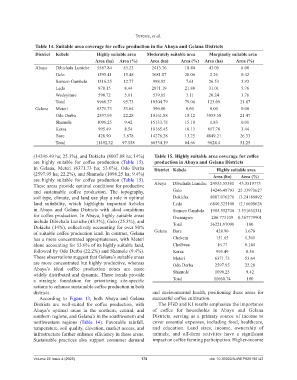
                 Table 14. Suitable area coverage for coffee production in the Abaya and Gelana Districts
                 District  Kebele           Highly suitable area  Moderately suitable area   Marginally suitable area
                                           Area (ha)  Area (%)     Area (ha)     Area (%)  Area (ha)     Area (%)
                 Abaya    Dibichala Luniche  5587.84   53.23        2413.76       18.40      43.05         8.00
                          Gelo              1595.41    15.48        3681.07       28.06      2.26          0.42
                          Semero Gambela    1316.25    12.77        998.92         7.61      26.53         3.93
                          Ledo              870.15      8.44        2871.19       21.88      31.01         5.76
                          Wedeyiture        598.72      5.81        539.85         3.11      20.24         3.76
                          Total             9968.37    95.73       10504.79       79.06     123.09         21.87
                 Gelana   Meteri            6371.73    53.64        596.80         0.60      0.00          0.00
                          Odo Derba         2597.95    22.28       18161.88       18.12     3955.58        21.47
                          Shamole           1098.25     9.42       15133.78       15.10      1.83          0.01
                          Kersa             995.49      8.54       18165.45       18.13     817.78         3.44
                          Bore              428.90     3.678       14276.28       13.25     4849.21        26.33
                          Total            11492.32    97.558      66334.19       64.66     9624.4         51.25


                (14246.49 ha; 25.3%), and Dokicha (8007.08 ha; 14%)   Table 15. Highly suitable area coverage for coffee
                are highly suitable  for  coffee  production  (Table  15).   production in Abaya and Gelana Districts
                In  Gelana,  Meteri  (6371.73  ha;  53.6%),  Odo  Derba   District Kebele       Highly suitable area
                (2597.95 ha; 22.2%), and Shamole (1098.25 ha; 9.4%)                            Area (ha)   Area (%)
                are highly suitable  for  coffee  production  (Table  15).
                These areas provide optimal conditions for productive   Abaya  Dibichala Luniche 24935.55581  43.3519773
                and  sustainable  coffee  production.  The  topography,      Gelo             14246.48793 25.33971627
                soil type, climate, and land use play a role in optimal      Dokicha          8007.076278 13.24189892
                land  suitability, which  highlights  important  kebeles     Ledo             6840.525108 12.16699626
                in  Abaya  and  Gelana  Districts  with  ideal  conditions   Semero Gambela   1985.552748 3.531631341
                for coffee production. In Abaya, highly suitable areas       Gwanigwa         206.773109  0.367779901
                include Dibichala Luniche (43.3%), Gelo (25.3%), and         Total            56221.97098     100
                Dokicha (14%), collectively accounting for over 80%
                of suitable coffee production land. In contrast, Gelana   Gelana  Bore          428.90       3.678
                has a more concentrated appropriateness, with Meteri         Cheketa            151.65       1.301
                alone accounting for 53.6% of its highly suitable land,      Chelbesa            16.77       0.144
                followed by Odo Derba (22.2%) and Shamole (9.4%).            Kersa              995.49       8.54
                These observations suggest that Gelana’s suitable areas      Meteri             6371.73      53.64
                are more concentrated but highly productive, whereas         Odo Derba          2597.95      22.28
                Abaya’s  ideal  coffee  production  zones  are  more
                widely distributed and dynamic. These trends provide         Shamole            1098.25      9.42
                a  strategic  foundation  for  prioritizing  site-specific   Total             11660.74       100
                actions to enhance sustainable coffee production in both
                districts.                                          and environmental  health,  positioning  these  areas for
                  According to  Figure  13,  both  Abaya  and  Gelana   successful coffee cultivation.
                Districts  are  well-suited  for  coffee  production,  with   The FGD and KI results emphasize the importance
                Abaya’s  optimal areas in the northern, central, and   of  coffee  for  households  in  Abaya  and  Gelana
                southern regions, and Gelana’s in the southwestern and   Districts, serving as a primary source of income to
                northwestern  regions  (Table  14). Favorable  rainfall,   cover essential expenses, including food, healthcare,
                temperature, soil quality, elevation, market access, and   and  education.  Land  sizes,  income,  ownership  of
                infrastructure further enhance efficiency in these areas.   animals,  and  off-farm  activities  have  a  significant
                Sustainable  practices  also  support  consumer  demand   impact on coffee farming participation. Higher-income


                Volume 22 Issue 4 (2025)                       172                           doi: 10.36922/AJWEP025190143

