


Page 28 - AJWEP-22-4
P. 28
Tekulu and Islam

                  Studies suggest that waste is not just a technical
                challenge  but  reflects  deeper  issues  of  social
                marginalization and environmental justice.  Conflicts,
                                                      27
                such as in Ukraine and Syria, have caused long-lasting
                damage to waste infrastructure, resulting in uncontrolled
                disposal  and  health  risks. 28,29  Disrupted  governance,
                displaced  populations,  and  damaged  logistics  pose
                challenges  in  restoring  waste  services  post-conflict.
                Moreover, international  humanitarian  responses may
                inadvertently generate additional waste, stressing already
                fragile systems and further complicating  recovery.
                Lebanon’s 2015 waste crisis highlighted the failures of
                decentralized governance and the urgency of integrated
                SWM.  30,31  In many  African cities,  non-governmental
                organizations,  community-based  organizations,  and
                the private sector now play vital roles in SWM due to
                municipal limitations.  These key players often bring
                                   32
                innovation,  community  engagement,  and  localized
                knowledge, which are essential to adaptive and context-
                specific solutions. Bangladesh’s experience shows that
                structured public–private  partnerships can enhance
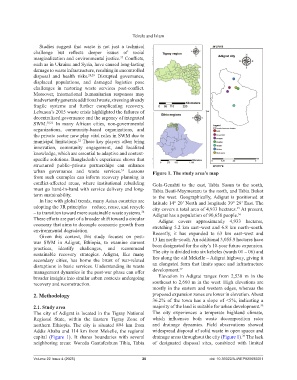
                urban governance  and waste services.  Lessons      Figure 1. The study area’s map
                                                      33
                from such examples can inform recovery planning in
                conflict-affected  areas,  where  institutional  rebuilding   Gola-Genahti to the east,  Tabia Sasun to the south,
                must go hand-in-hand with service delivery and long-  Tabia Beati-Maymesanu to the north, and Tabia Bukot
                term sustainability.                                to the west. Geographically, Adigrat is positioned  at
                  In line with global trends, many Asian countries are   latitude 14° 20’ North and longitude 39° 29’ East. The
                adopting the 3R principles – reduce, reuse, and recycle   city covers a total area of 4,933 hectares.  At present,
                                                                                                         35
                – to transition toward more sustainable waste systems.    Adigrat has a population of 90,658 people. 36
                                                               34
                These efforts are part of a broader shift toward a circular   Adigrat covers approximately  4,933 hectares,
                economy that aims to decouple economic growth from   stretching  5.2  km east–west  and 6.8  km north–south.
                environmental degradation.                          Recently,  it  has  expanded  to  63  km  east–west  and
                  Given this context,  this  study focuses on post-
                war SWM in  Adigrat, Ethiopia, to examine  current   13 km north–south. An additional 3,055.9 hectares have
                practices,  identify  challenges,  and recommend    been designated for the city’s 10-year future expansion.
                sustainable  recovery  strategies.  Adigrat,  like  many   The city is divided into six kebeles (wards 01 – 06) and
                secondary  cities,  has borne the  brunt of war-related   lies along the old Mekelle – Adigrat highway, giving it
                disruptions in basic services. Understanding its waste   an elongated form that limits space and infrastructure
                management dynamics in the post-war phase can offer   development. 37
                broader insights into similar urban contexts undergoing   Elevation  in  Adigrat ranges from 2,530  m in the
                recovery and reconstruction.                        southeast to 2,660 m in the west. High elevations are
                                                                    mostly in the eastern and western edges, whereas the
                2. Methodology                                      proposed expansion zones are lower in elevation. About
                                                                    36.2% of the town has a slope of <5%, indicating  a
                                                                                                                    38
                2.1. Study area                                     majority of the land is suitable for urban development.
                The city of Adigrat is located in the Tigray National   The city experiences  a temperate  highland climate,
                Regional State, within the Eastern  Tigray Zone of   which  influences  both  waste  decomposition  rates
                northern Ethiopia.  The city is situated  894  km from   and drainage dynamics. Field observations showed
                Addis Ababa and 114 km from Mekelle, the regional   widespread disposal of solid waste in open spaces and
                capital  (Figure  1). It shares boundaries  with several   drainage areas throughout the city (Figure 1).  The lack
                                                                                                            39
                neighboring  areas:  Woreda  Gantafeshum  Tibia,  Tabia   of designated  disposal  sites,  combined  with  limited


                Volume 22 Issue 4 (2025)                        20                           doi: 10.36922/AJWEP025090061

