


Page 31 - AJWEP-22-4
P. 31
Post-war solid waste management in Adigrat Ethiopia

                 Table 4. Satisfactory rating of the municipal solid
                 waste management

                 Satisfaction   No. of   Frequency   Cumulative
                 level       respondents    (%)     frequency (%)
                 Poor            40         24.24       24.24
                 Good            20         12.12       12.12
                 Satisfied       20         12.12       12.12
                 Unsatisfied     85         51.2        24.24
                 Total           165        100         100


                 Table 5. Consequences of the dispersed solid waste
                 management
                 Problems       No. of   Frequency   Cumulative
                             respondents    (%)       frequency
                                                        (%)
                 Odor problem    80         48.5        48.5
                 Blockage of     30         18.2        18.2
                 drainage
                 Waste beside    20         12.12       12.12
                 the road
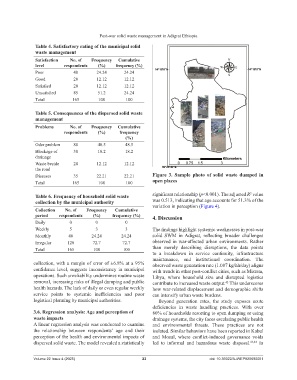
                 Diseases        35         22.21       22.21       Figure  3. Sample  photo of solid waste dumped in
                 Total           165        100         100         open places


                 Table 6. Frequency of household solid waste        significant relationship (p<0.001). The adjusted R² value
                 collection by the municipal authority              was 0.513, indicating that age accounts for 51.3% of the
                                                                    variation in perception (Figure 4).
                 Collection   No. of   Frequency    Cumulative
                 period    respondents    (%)      frequency (%)    4. Discussion
                 Daily          0          0            0
                 Weekly         5          3            3           The findings highlight systemic weaknesses in post-war
                 Monthly       40        24.24        24.24         solid  SWM  in  Adigrat,  reflecting  broader  challenges
                 Irregular     120        72.7         72.7         observed  in  war-affected  urban  environments.  Rather
                 Total         165        100          100          than merely  describing disruptions, the data points
                                                                    to a breakdown in service continuity, infrastructure
                                                                    maintenance,  and institutional  coordination.  The
                collection, with a margin of error of ±6.8% at a 95%   observed waste generation rate (1.087 kg/hh/day) aligns
                confidence  level,  suggests  inconsistency  in  municipal   with trends in other post-conflict cities, such as Misrata,
                operations. Such unreliability undermines routine waste   Libya,  where household size  and disrupted  logistics
                removal, increasing risks of illegal dumping and public   contribute to increased waste output.  This underscores
                                                                                                    42
                health hazards. The lack of daily or even regular weekly   how war-related displacement and demographic shifts
                service  points  to  systemic  inefficiencies  and  poor   can intensify urban waste burdens.
                logistical planning by municipal authorities.          Beyond generation  rates, the study exposes acute
                                                                    deficiencies  in  waste  handling  practices.  With  over
                3.6. Regression analysis: Age and perception of     80% of households resorting to open dumping or using
                waste impacts                                       drainage systems, the city faces escalating public health
                A linear regression analysis was conducted to examine   and environmental  threats.  These practices are not
                the  relationship  between  respondents’ age  and their   isolated. Similar behaviors have been reported in Kabul
                perception of the health and environmental impacts of   and  Mosul,  where  conflict-induced  governance  voids
                dispersed solid waste. The model revealed a statistically   led  to informal  and hazardous  waste  disposal. 43,44  In


                Volume 22 Issue 4 (2025)                        23                           doi: 10.36922/AJWEP025090061

