


Page 30 - AJWEP-22-4
P. 30
Tekulu and Islam

                 Table 2. Family size and waste generation rate      Table 3. The municipal solid waste disposal
                 Family   No. of   Percentage Waste generation rate   system’s frequency and cumulative frequency
                 size    families             (kg/household/day)     Disposal      No. of    Frequency   Cumulative
                 1 – 2     20       12.1            0.32             system      respondents    (%)     frequency (%)
                 3 – 4     50       30.3            1.29             Open dump       80        48.5         48.4
                 5 – 6     80       48.5            1.34             To the waste    30        18.2         18.18
                 >7        15        6               1.4             collector
                 Total     165       100      4.35 (average: 1.087)  Throwing        55        33.3         33.3
                                                                     into the
                                                                     drainage
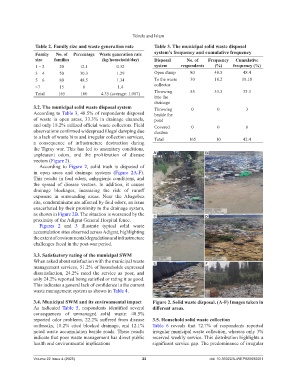
                3.2. The municipal solid waste disposal system       Throwing        0           0           3
                According to Table 3, 48.5% of respondents disposed   beside the
                of  waste  in  open  areas,  33.3%  in  drainage  channels,   pond
                and only 18.2% utilized official waste collectors. Field   Covered   0           0           6
                observations confirmed widespread illegal dumping due   dustbin
                to a lack of waste bins and irregular collection services,   Total  165         10          42.4
                a consequence  of infrastructure  destruction  during
                the Tigray war. This has led to unsanitary conditions,
                unpleasant  odors, and the proliferation  of disease   A                   B
                vectors (Figure 2).
                  According  to  Figure  2, solid  trash  is disposed of
                in open areas and drainage systems (Figure  2A-F).
                This results in foul odors, unhygienic conditions, and
                the spread of disease vectors. In addition, it causes
                drainage  blockages,  increasing  the  risk  of  runoff
                exposure  in  surrounding areas.  Near  the  Abagobez
                site, condominiums are affected by foul odors, an issue
                exacerbated by their proximity to the drainage system,
                as shown in Figure 2B. The situation is worsened by the   C                D
                proximity of the Adigrat General Hospital fence.
                  Figures  2 and  3 illustrate typical solid waste
                accumulation sites observed across Adigrat, highlighting
                the extent of environmental degradation and infrastructure
                challenges faced in the post-war period.

                3.3. Satisfactory rating of the municipal SWM
                When asked about satisfaction with the municipal waste   E                 F
                management services, 51.2% of households expressed
                dissatisfaction,  24.2% rated  the  service  as poor, and
                only 24.2% reported being satisfied or rating it as good.
                This indicates a general lack of confidence in the current
                waste management system as shown in Table 4.

                3.4. Municipal SWM and its environmental impact     Figure 2. Solid waste disposal. (A-F) Images taken in
                As indicated  Table  5,  respondents  identified  several   different areas.
                consequences  of unmanaged  solid  waste:  48.5%
                reported  odor  problems,  22.2%  suffered  from  disease   3.5. Household solid waste collection
                outbreaks, 18.2% cited  blocked drainage,  and 12.1%   Table  6 reveals  that  72.7% of  respondents  reported
                noted waste accumulation beside roads. These results   irregular municipal waste collection, whereas only 3%
                indicate that poor waste management has direct public   received weekly service. This distribution highlights a
                health and environmental implications               significant service gap. The predominance of irregular


                Volume 22 Issue 4 (2025)                        22                           doi: 10.36922/AJWEP025090061

