


Page 99 - AJWEP-22-4
P. 99
Conservation of the vulnerable Vitellaria Paradoxa

                States Department of Agriculture.  However, in tropical   the north. The mean annual temperature is around 26°C,
                                             24
                regions, total annual rainfall and its distribution play a   with little or no seasonal variation. 1
                more significant role in determining plant distribution
                and survival, as temperature remains relatively uniform   2.2. Shea nut tree (V. paradoxa) occurrence data
                with little  or no seasonal  variation.   This  is true  for   The occurrence data of V. paradoxa were obtained from
                                                25
                the study area in the present project, where the average   field surveys and the Global Biodiversity Information
                annual temperature rarely exceeds 30°C and shows little   Facility (GBIF). Field data were collected from March
                or no seasonal variation.                           to August 2021 and from October to November 2024,
                  This study seeks to answer the following questions:   while GBIF data were accessed on November 26, 2024
                (i) Where is the suitable habitat for V. paradoxa? (ii) What   (occurrence data and citations in  Appendix  A1  and
                are the essential vegetation phenotype parameters that   Table S1). Special attention was paid to the identification
                can guide the selection  of viable/healthy  seeds for   of V. paradoxa in the field with the aid of local guides and
                V.  paradoxa  propagation?  and  (iii)  Can  the  locations   experts. The data collected from both sources included
                where viable seeds can be sourced and the associated   species name, geographic coordinates  (in decimal
                seed zone in the study area be identified? Accordingly,   degrees), sources of information (for data collected from
                this study applied remote sensing imaging technologies   GBIF), and the name of the closest settlement  (only
                to extract vegetation-related  phenotypic and climatic   in  the  field  survey). Additional  information  collected
                data  for habitat  suitability  or SDM, with  the  goal  of   included the date and time of each observation.
                identifying suitable sites and potential sources of viable   For GBIF data, all  duplicates and entries  with
                and healthy seeds for V. paradoxa.                  questionable  geographic coordinates were removed.
                                                                    The remaining points were spatially thinned at a 1 km
                2. Materials and methods                            resolution using the “spThin” package in R  to minimize
                                                                                                         26
                                                                    spatial or geographical bias commonly associated with
                2.1. Study area                                     large online databases. This resulted in a total of 100
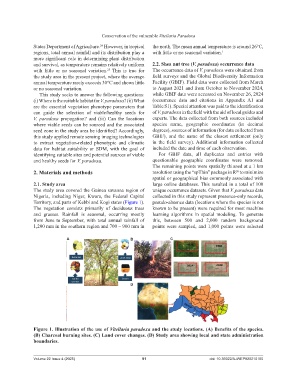
                The study area covered the Guinea savanna region of   unique occurrence datasets. Given that V. paradoxa data
                Nigeria, including  Niger, Kwara, the Federal Capital   collected in this study represent presence-only records,
                Territory, and parts of Kebbi and Kogi states (Figure 1).   pseudo-absence data (locations where the species is not
                The  vegetation consists primarily  of deciduous  trees   known to be present) were required for most machine
                and grasses. Rainfall  is seasonal,  occurring  mostly   learning algorithms in spatial modeling.  To generate
                from June to September, with total annual rainfall of   this, between  500 and 2,000 random background
                1,200 mm in the southern region and 700 – 900 mm in   points were sampled, and 1,000 points were selected


                              A                           B                 C


                                                          D


                Figure 1. Illustration of the use of Vitellaria paradoxa and the study locations. (A) Benefits of the species.
                (B) Charcoal burning sites. (C) Land cover changes. (D) Study area showing local and state administration
                boundaries.


                Volume 22 Issue 4 (2025)                        91                           doi: 10.36922/AJWEP025210160

