


Page 100 - AJWEP-22-4
P. 100
Salako, et al.

                as optimal  based  on a  cross-validation  score  >0.7.   assess the geographic  coordinates  of  questionable
                These random background points were used as pseudo-  occurrence data obtained from GBIF.
                absence data to characterize the modeling environment   A total of six image scenes were downloaded from
                in the study area.  The combined data (presence and   the USGS  EarthExplorer, covering the spatial extent
                                27
                background data/pseudo-absence  records) were then   of the study area along Landsat paths 189 – 191 and
                used to calibrate the model.                        rows 053 – 054. From each scene, four spectral bands
                                                                    were  selected:  the  green  band  (Band  3),  red  band
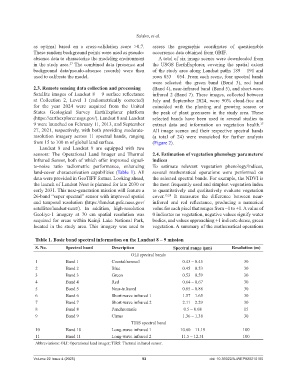
                2.3. Remote sensing data collection and processing  (Band 4), near-infrared band (Band 5), and short-wave
                Satellite  images  of  Landsat  8  –  9  surface  reflectance   infrared 2 (Band 7). These images, collected between
                at  Collection  2, Level  1 (radiometrically  corrected)   July and September  2024, were 90% cloud-free  and
                for  the  year  2024  were  acquired  from  the  United   coincided  with the planting and growing season or
                States  Geological  Survey EarthExplorer  platform   the peak of plant greenness in the study area.  These
                (https://earthexplorer.usgs.gov/). Landsat 8 and Landsat   selected  bands have  been  used in  several  studies  to
                9 were launched on February 11, 2013, and September   extract  data  and information  on vegetation  health.
                                                                                                                    17
                27, 2021, respectively, with both providing moderate-  All image scenes and their respective  spectral bands
                resolution  imagery  across 11 spectral  bands, ranging   (a total of 24) were mosaicked for further analysis
                from 15 to 100 m of global land surface.            (Figure 2).
                  Landsat  8  and  Landsat  9  are  equipped  with  two
                sensors:  The  Operational  Land  Imager  and  Thermal   2.4. Estimation of vegetation phenology parameters/
                Infrared Sensor, both of which offer improved signal-  indices
                to-noise ratio radiometric  performance,  enhancing   To estimate  relevant  vegetation  phenology/indices,
                land-cover  characterization  capabilities  (Table  1). All   several mathematical  operations were performed on
                data were provided in GeoTIFF format. Looking ahead,   the selected spectral bands. For example, the NDVI is
                the launch of Landsat Next is planned for late 2030 or   the most frequently used and simplest vegetation index
                early 2031. This next-generation mission will feature a   to quantitatively and qualitatively evaluate vegetation
                26-band “super spectral” sensor with improved spatial   cover. 15,28   It  measures  the  difference  between  near-
                and  temporal  resolution (https://landsat.gsfc.nasa.gov/  infrared  and  red  reflectance,  producing  a  numerical
                satellites/landsat-next/).  In addition,  high-resolution   value for each pixel that ranges from −1 to +1. A value of
                GeoEye-1 imagery at 70  cm spatial resolution was   0 indicates no vegetation, negative values signify water
                acquired  for  areas  within  Kainji  Lake  National  Park,   bodies, and values approaching +1 indicate dense, green
                located  in  the  study  area.  This  imagery  was used  to   vegetation. A summary of the mathematical operations


                 Table 1. Basic band spectral information on the Landsat 8 – 9 mission
                 S. No.       Spectral band       Description                Spectral range (μm)       Resolution (m)
                                                           OLI spectral bands
                 1            Band 1              Coastal/aerosol                0.43 – 0.45                30
                 2            Band 2              Blue                           0.45 – 0.53                30
                 3            Band 3              Green                          0.53 – 0.59                30
                 4            Band 4              Red                            0.64 – 0.67                30
                 5            Band 5              Near-infrared                  0.85 – 0.88                30
                 6            Band 6              Short-wave infrared 1          1.57 – 1.65                30
                 7            Band 7              Short-wave infrared 2          2.11 – 2.29                30
                 8            Band 8              Panchromatic                    0.5 – 0.68                15
                 9            Band 9              Cirrus                         1.36 – 1.38                30
                                                           TIRS spectral band
                 10           Band 10             Long-wave infrared 1          10.60 – 11.19               100
                 11           Band 11             Long-wave infrared 2           11.5 – 12.51               100
                 Abbreviations: OLI: Operational land imager; TIRS: Thermal infrared sensor.


                Volume 22 Issue 4 (2025)                        92                           doi: 10.36922/AJWEP025210160

