


Page 115 - AJWEP-22-5
P. 115
Economic analysis: Shaanxi waste recycling

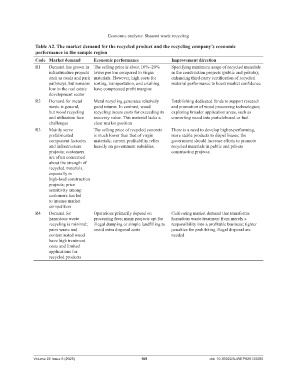
                 Table A2. The market demand for the recycled product and the recycling company’s economic
                 performance in the sample region

                 Code Market demand       Economic performance               Improvement direction
                 R1    Demand has grown in  The selling price is about 10%–20%   Specifying minimum usage of recycled materials
                       infrastructure projects  lower per ton compared to virgin   in the construction projects (public and private);
                       such as roads and park  materials. However, high costs for   enhancing third-party certification of recycled
                       pathways, but remains  sorting, transportation, and crushing   material performance to boost market confidence
                       low in the real estate   have compressed profit margins
                       development sector
                 R2    Demand for metal   Metal recycling generates relatively   Establishing dedicated funds to support research
                       waste is general,   good returns. In contrast, wood   and promotion of wood processing technologies;
                       but wood recycling   recycling incurs costs far exceeding its   exploring broader application areas, such as
                       and utilization face   recovery value. This material lacks a   converting wood into particleboard or fuel
                       challenges         clear market position
                 R3    Mainly serve       The selling price of recycled concrete   There is a need to develop higher-performing,
                       prefabricated      is much lower than that of virgin   more stable products to dispel biases; the
                       component factories   materials; current profitability relies   government should increase efforts to promote
                       and infrastructure   heavily on government subsidies.  recycled materials in public and private
                       projects; customers                                   construction projects.
                       are often concerned
                       about the strength of
                       recycled materials,
                       especially in
                       high-load construction
                       projects; price
                       sensitivity among
                       customers has led
                       to intense market
                       competition
                 R4    Demand for         Operations primarily depend on     Cultivating market demand that transforms
                       hazardous waste    processing fees; many projects opt for   hazardous waste treatment from merely a
                       recycling is minimal;   illegal dumping or simple landfilling to   responsibility into a profitable business; tighter
                       paint waste and    avoid extra disposal costs         penalties for prohibiting illegal disposal are
                       contaminated wood                                     needed
                       have high treatment
                       costs and limited
                       applications for
                       recycled products


                Volume 22 Issue 5 (2025)                       109                           doi: 10.36922/AJWEP025120080

