


Page 167 - AJWEP-22-5
P. 167
Emission and carbon policy analysis

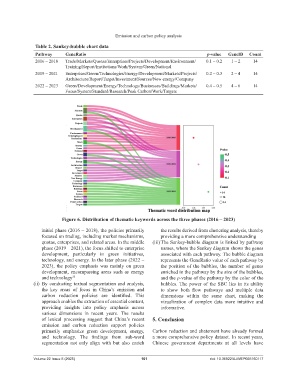
                 Table 2. Sankey-bubble chart data
                 Pathway      GeneRatio                                                     p-value  GeneID    Count
                 2016 – 2018  Trade/Markets/Quotas/Enterprises/Projects/Development/Environment/  0.1 – 0.2  1 – 2  14
                              Training/Report/Institutions/Work/System/Green/National
                 2019 – 2021  Enterprises/Green/Technologies/Energy/Development/Markets/Projects/  0.2 – 0.3  2 – 4  14
                              Architecture/Report/Target/Investment/Sources/New energy/Company
                 2022 – 2023  Green/Development/Energy/Technology/Businesses/Buildings/Markets/  0.4 – 0.5  4 – 6  14
                              Focus/System/Standard/Research/Peak Carbon/Work/Targets


                            Figure 6. Distribution of thematic keywords across the three phases (2016 – 2023)

                   initial phase (2016 – 2018), the policies primarily   the results derived from clustering analysis, thereby
                   focused on trading, including market mechanisms,     providing a more comprehensive understanding
                   quotas, enterprises, and related areas. In the middle   (iii) The Sankey-bubble diagram is linked by pathway
                   phase (2019 – 2021), the focus shifted to enterprise   names, where the Sankey diagram shows the genes
                   development,  particularly  in  green  initiatives,   associated with each pathway. The bubble diagram
                   technology, and energy. In the later phase (2022 –   represents the GeneRatio value of each pathway by
                   2023), the policy emphasis was mainly  on green      the position of the bubbles, the number of genes
                   development,  encompassing areas such as energy      enriched in the pathway by the size of the bubbles,
                   and technology 35                                    and the p-value of the pathway by the color of the
                (ii)  By conducting textual segmentation and analysis,   bubbles. The power of the SBC lies in its ability
                   the key areas of focus in China’s emission and       to  show  both  flow  pathways  and  multiple  data
                   carbon  reduction  policies  are  identified.  This   dimensions  within  the  same  chart, making  the
                   approach enables the extraction of essential content,   visualization  of complex  data  more intuitive  and
                   providing  insights  into  policy  emphasis  across   informative.
                   various dimensions in recent years.  The results
                   of lexical processing suggest that China’s recent   5. Conclusion
                   emission  and  carbon  reduction  support  policies
                   primarily emphasize green development,  energy,   Carbon reduction and abatement have already formed
                   and  technology.  The  findings  from  sub-word   a more comprehensive policy dataset. In recent years,
                   segmentation  not only align with but also enrich   Chinese government departments at all levels have


                Volume 22 Issue 5 (2025)                       161                           doi: 10.36922/AJWEP025160117

