


Page 65 - AJWEP-22-5
P. 65
Performance and applications of dewatering technologies

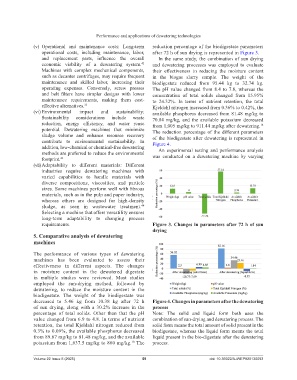
                (v)  Operational  and maintenance  costs: Long-term   reduction percentage of the biodigestate parameters
                   operational  costs, including maintenance,  labor,   after 72 h of sun drying is represented in Figure 3.
                   and  replacement  parts,  influence  the  overall   In the same study, the combination of sun drying
                   economic  viability  of a dewatering  system.    and dewatering processes was employed to evaluate
                                                               42
                   Machines  with  complex  mechanical  components,   their  effectiveness  in  reducing  the  moisture  content
                   such as decanter centrifuges, may require frequent   in the biogas slurry sample.  The weight of the
                   maintenance  and skilled  labor, increasing  their   biodigestate reduced from 95.44  kg to 32.74  kg.
                   operating  expenses.  Conversely,  screw presses   The  pH  value  changed  from  8.4  to  7.8,  whereas  the
                   and  belt  filters  have  simpler  designs  with  lower   concentration of total solids changed from 15.95%
                   maintenance  requirements,  making them cost-    to 24.32%. In terms of nutrient retention, the total
                   effective alternatives. 33                       Kjeldahl nitrogen increased from 0.36% to 0.42%, the
                (vi) Environmental  impact    and   sustainability:  available phosphorus decreased from 81.48 mg/kg to
                   Sustainability  considerations  include  waste   70.84  mg/kg, and the available potassium decreased
                   reduction,  energy  efficiency,  and  water  reuse   from 1,005 mg/kg to 911.44 mg/kg after dewatering.
                                                                                                                    18
                   potential.  Dewatering machines  that minimize   The  reduction  percentage  of  the  different  parameters
                   sludge volume and enhance  resource recovery     of the biodigestate after dewatering is represented in
                   contribute  to environmental  sustainability. In   Figure 4.
                   addition, low-chemical or chemical-free dewatering
                   methods are preferred to reduce the environmental   An experimental  testing  and  performance  analysis
                   footprint. 43                                    was conducted on a dewatering  machine  by varying
                (vii) Adaptability  to  different  materials:  Different
                   industries require dewatering machines with
                   varied capabilities to handle materials with
                   diverse compositions, viscosities, and particle
                   sizes. Some machines perform well with fibrous
                   materials, such as in the pulp and paper industry,
                   whereas others are designed for high-density
                   sludge, as seen in wastewater treatment.
                                                               44
                   Selecting a machine that offers versatility ensures
                   long-term adaptability to changing process
                   requirements.                                    Figure 3. Changes in parameters after 72 h of sun
                                                                    drying
                5. Comparative analysis of dewatering
                machines


                The performance of various types of dewatering
                machines has been evaluated to assess their
                effectiveness in  different  aspects.  The changes
                in moisture content in the dewatered digestate
                in  multiple  studies  were  reviewed.  Most  studies
                employed the sun-drying method, followed by
                dewatering, to reduce the moisture content in the
                biodigestate.  The weight of the biodigestate was
                decreased to 5.46  kg from 10.38  kg after 72  h    Figure 4. Changes in parameters after the dewatering
                of  sun  drying,  along with  a  30.2% increase  in  the   process
                percentage  of  total  solids.  Other  than  that  the  pH   Note:  The solid and liquid form both uses the
                value changed from 6.9 to 4.8. In terms of nutrient   combination of sun-drying and dewatering process. The
                retention, the total Kjeldahl nitrogen reduced from   solid form means the total amount of solid present in the
                0.3% to 0.09%, the available phosphorus decreased   biodigestate, whereas the liquid form means the total
                from 89.67 mg/kg to 81.48 mg/kg, and the available   liquid present in the bio-digestate after the dewatering
                potassium from 1,637.5 mg/kg to 860 mg/kg.  The     process.
                                                           18


                Volume 22 Issue 5 (2025)                        59                           doi: 10.36922/AJWEP025130093

