


Page 63 - AJWEP-22-5
P. 63
Performance and applications of dewatering technologies

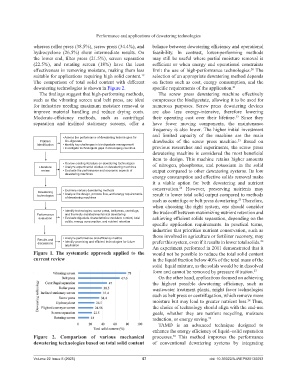
                whereas roller press (38.5%), screw press (34.4%), and   balance between dewatering efficiency and operational
                hydrocyclone  (26.5%) show intermediate  results.  On   feasibility. In contrast, lower-performing methods
                the  lower  end,  filter  press  (21.5%),  screen  separation   may still be useful where partial moisture removal is
                (22.5%), and rotating  screen (18%) have the least   sufficient  or  when  energy  and  operational  constraints
                effectiveness in removing moisture, making them less   limit the use of high-performance technologies.  The
                                                                                                               20
                suitable for applications requiring high solid content.    selection of an appropriate dewatering method depends
                                                               19
                The  comparison  of  total  solid  content  with  different   on factors such as cost, energy consumption, and the
                dewatering technologies is shown in Figure 2.       specific requirements of the application. 21
                  The findings suggest that high-performing methods,   The  screw  press  dewatering  machine  effectively
                such as the  vibrating  screen  and belt  press, are  ideal   compresses the biodigestate, allowing it to be used for
                for industries needing maximum moisture removal to   numerous purposes. Screw press dewatering devices
                improve  material  handling  and  reduce  drying  costs.   are also less energy-intensive,  therefore  lowering
                Moderate-efficiency  methods,  such  as  centrifugal   their  operating  cost  over  their  lifetime.  Since  they
                                                                                                         22
                separation  and  inclined  stationary  screens,  offer  a   have fewer moving components,  the maintenance
                                                                    frequency is also lower. The higher initial investment
                                                                    and limited  capacity  of the machine  are the  main
                             • Assess the performance of dewatering technologies for
                                                                                                          23
                   Problem     bio-digestate                        drawbacks of the screw press machine.  Based on
                 identification  • Identify key challenges in bio-digestate management
                             • Investigate technological gaps in developing countries  previous researches and experiments, the screw press
                                                                    dewatering machine is considered the most beneficial
                                                                    item to design.  This machine retains higher amounts
                             • Review existing literature on dewatering technologies  of nitrogen,  phosphorus, and potassium  in the solid
                  Literature  • Analyze experimental studies on dewatering machines
                   review    • Evaluate the performance and economic aspects of  output compared to other dewatering systems. Its low
                               dewatering machines
                                                                    energy consumption and effective solids removal make
                                                                    it a viable option for both dewatering  and nutrient
                                                                    conservation.   However,  preserving  nutrients  may
                                                                                24
                             • Examine various dewatering methods
                  Dewatering
                 technologies  • Analyze the design, process flow, and energy requirements  result in lower total solid output compared to methods
                               of dewatering machines
                                                                    such as centrifuge or belt press dewatering.  Therefore,
                                                                                                          25
                                                                    when choosing the right system, one should consider
                             • Identify technologies: screw press, belt press, centrifuge,  the trade-off between maximizing nutrient retention and
                 Performance    and thermally assisted mechanical dewatering
                  evaluation  • Evaluate digestate characteristics: moisture content, total  achieving efficient solids separation, depending on the
                              solids, energy consumption, and nutrient retention
                                                                    specific  application  requirements.  In  practical  terms,
                                                                    industries that prioritize nutrient conservation, such as
                                                                    those involved in agriculture or fertilizer recovery, may
                  Results and  • Analyze performance and efficiency metrics  prefer this system, even if it results in lower total solids.
                                                                                                                    26
                             • Identify promising and efficient technologies for future
                  discussions
                               application                          An experiment performed in 2011 demonstrated that it
                Figure  1.  The systematic approach applied to the   would not be possible to reduce the total solid content
                current review                                      in the liquid fraction below 40% of the total mass of the
                                                                    solid–liquid mixture, as the solids would be in dissolved
                                                                    form and cannot be removed by pressure filtration. 27
                                                                       On the other hand, applications focused on achieving
                                                                    the  highest  possible  dewatering  efficiency,  such  as
                                                                    wastewater treatment plants, might favor technologies
                                                                    such as belt press or centrifugation, which remove more
                                                                    moisture but may lead to greater nutrient loss.  Thus,
                                                                                                              28
                                                                    the choice of technology should align with the end-use
                                                                    goals, whether they are nutrient recycling,  moisture
                                                                    reduction, or energy saving. 29
                                                                       TAMD  is an advanced technique  designed to
                                                                    enhance the energy efficiency of liquid–solid separation
                Figure  2. Comparison of various mechanical         processes.   This method improves the performance
                                                                             30
                dewatering technologies based on total solid content  of conventional dewatering systems by integrating


                Volume 22 Issue 5 (2025)                        57                           doi: 10.36922/AJWEP025130093

