


Page 66 - AJWEP-22-5
P. 66
Darlami, et al.

                                                                       Mahmoud  et al.  applied thermal-mechanical
                                                                                       31
                                                                    assisted dewatering (TMAD) to alfalfa biomass
                                                                    using a two-factor central composite experimental
                                                                    design.  At 80°C and pressure conditions ranging
                                                                    from 300 kPa to 3000 kPa, the method removed up to
                                                                    83% of inherent water, compared to only 43% using
                                                                    mechanical dewatering alone. A regression model with
                                                                    R  > 88% was used to predict final dry solid content. The
                                                                      2
                                                                    optimized process required <150  kWh/m , reducing
                                                                                                           3
                                                                    energy consumption by over 30% and achieving up to
                                                                    87% total solids after thermal drying.
                                                                       Marcel  et al.  developed  an integrated  milling-
                                                                                   48
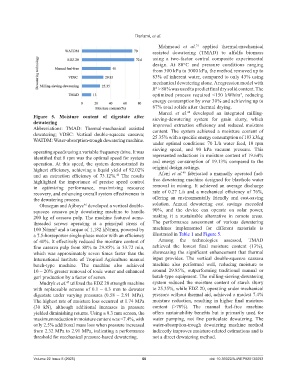
                Figure  5. Moisture content of digestate after      sieving-dewatering  system for grain slurry, which
                dewatering                                          improved  extraction  efficiency  and  reduced  moisture
                Abbreviations: TMAD: Thermal-mechanical  assisted   content.  The system achieved a moisture content of
                dewatering;  VDSC:  Vertical  double-squeeze  cassava;   25.35% with a specific energy consumption of 183 kJ/kg
                WATDM: Water-absorption-trough dewatering machine.
                                                                    under optimal conditions: 70 L/h water feed, 10 rpm
                operating speeds using a variable frequency drive. It was   sieving  speed, and 90 kPa vacuum  pressure.  This
                identified that 8 rpm was the optimal speed for system   represented reductions in moisture content of 19.64%
                operation. At this speed, the  system demonstrated  its   and  energy  consumption  of 19.13% compared  to  the
                highest efficiency, achieving a liquid yield of 92.02%   original design settings.
                                                                                 49
                and  an  extraction  efficiency  of  73.12%.  The  results   Afeni  et  al.   fabricated  a  manually  operated  fuel-
                                                    45
                highlighted  the importance  of precise speed control   free dewatering machine designed for blasthole water
                in  optimizing  performance,  maximizing  resource   removal  in mining. It achieved  an average  discharge
                recovery, and enhancing overall system effectiveness in   rate of 0.27 L/s and a mechanical efficiency of 76%,
                the dewatering process.                             offering  an  environmentally  friendly  and  cost-saving
                  Olusegun and Ajiboye  developed a vertical double-  solution.  Annual dewatering cost savings exceeded
                                      46
                squeeze  cassava  pulp  dewatering  machine  to  handle   90%, and the  device  can  operate  on solar power,
                200 kg of cassava pulp. The machine featured acme-  making  it  a  sustainable  alternative  in  remote  areas.
                threaded  screws operating  at  a  principal  stress of   The performance assessment of various dewatering
                100 N/mm  and a torque of 1,182 kN/mm, powered by   machines  implemented  for  different  materials  is
                         2
                a 7.5-horsepower single-phase motor with an efficiency   illustrated in Table 1 and Figure 5.
                of 40%. It effectively reduced the moisture content of   Among  the   technologies  assessed,  TMAD
                fine cassava pulp from 80% to 29.85% in 33.72 min,   achieved  the  lowest  final  moisture  content  (13%),
                which was approximately seven times faster than the   showcasing  the  significant  enhancement  that  thermal
                International  Institute  of  Tropical Agriculture  manual   input  provides.  The  vertical  double-squeeze  cassava
                batch-type  machine.  The machine  also achieved    machine  also  performed  well,  reducing  moisture  to
                10 – 20% greater removal of toxic water and enhanced   around  29.85%, outperforming traditional  manual  or
                gari production by a factor of seven.               batch-type equipment. The milling-sieving-dewatering
                  Mudryk et al.  utilized the EDZ 20 strength machine   system reduced the moisture content  of starch slurry
                              47
                with replaceable screens of 0.1 – 0.3 mm to dewater   to 25.35%, while EDZ 20, operating under mechanical
                digestate under varying pressures (0.58 – 2.91 MPa).   pressure without thermal aid, achieved a modest 7.4%
                The highest rate of moisture loss occurred at 1.74 MPa   moisture  reduction,  resulting  in  higher  final  moisture
                (30  kN),  although  additional  increases  in  pressure   content  (>70%).  The manual fuel-free machine
                yielded diminishing returns. Using a 0.3 mm screen, the   offers sustainability benefits but is primarily used for
                maximum reduction in moisture content was <7.4%, with   water  pumping,  not  fine  particulate  dewatering.  The
                only 2.5% additional mass loss when pressure increased   water-absorption-trough  dewatering  machine  method
                from 2.32 MPa to 2.91 MPa, indicating a performance   indirectly improves moisture-related estimations and is
                threshold for mechanical pressure-based dewatering.  not a direct dewatering method.


                Volume 22 Issue 5 (2025)                        60                           doi: 10.36922/AJWEP025130093

