


Page 67 - AJWEP-22-5
P. 67
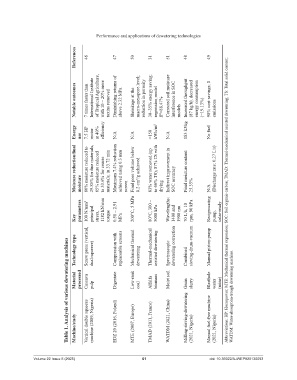
Performance and applications of dewatering technologies


                                  References  46    47      50      31      51     48         49


                                  Notable outcomes  7 times faster than   International Institute   of Tropical Agriculture,   with 10 – 20% more   toxins removed  Diminishing returns of   above 2.32 MPa  Shrinkage at the   macro-mesopore level;   reduction in porosity  30–35% energy saving;   regression model   R 2 =88.47%  Corrected soil moisture   interference in SOC   models  Increased throughput   (87 kg/h), decreased   energy consumption   (−19.13%)  90% cost savings; 0   emissions


                                  Energy   use  7.5 HP   motor   at 40%   efficiency  N/A  N/A  <150   kWh/m 3  N/A  183 kJ/kg  No fuel


                                  Moisture reduction/final   moisture  80% moisture reduced to   29.85% for fine materials,   65% moisture reduced   to 33.6% for coarse   materials, in 33.72 min  Maximum 7.4% reduction   achieved using 0.3 mm   screen  Final pore volume below   0.2 cm 3 /g achieved  83% water removed (up   to 66% TS); 87% TS with   drying  Indirect improvement in   SOC accuracy  Final moisture content:   25.35%  N/A   (Discharge rate: 0.27 L/s)


                                     parameters  100 N/mm 2    principal   1182 kN/mm   0.58 – 2.91   200°C, 5 MPa  80°C, 300 –   3000 kPa  Wavelengths:   1400 and   1900 nm  70 L/h, 10   rpm, 90 kPa  Reciprocating   solar-ready Abbreviations: HP: Horsepower; MTE: Mechanical thermal expression; SOC: Soil organic carbon; TMAD: Thermal-mechanical assisted dewatering; TS: Total solid content;

                                  Key       stress,   torque  MPa                               pump,


                                  Technology type  Screw press (vertical,   dual-squeeze)  Compression with   replaceable screens  Mechanical thermal   dewatering  Thermal-mechanical   assisted dewatering  Spectroscopic   dewatering correction  Combined   sieving-drum-vacuum  Manual piston-pump
                               Table 1. Analysis of various dewatering machines


                                  Material   processed  Cassava   pulp  Digestate  Low-rank   coal  Alfalfa   biomass  Moist soil  Grain   slurry  Blasthole   water   (mine) WATDM: Water-absorption-trough dewatering machine.


                                  Machine/study  Vertical double squeeze   machine (2009, Nigeria)  EDZ 20 (2016, Poland)  MTE (2007, Europe)  TMAD (2011, France)  WATDM (2021, China)  Milling-sieving-dewatering   (2021, Nigeria)  Manual fuel-free machine   (2021, Nigeria)


                Volume 22 Issue 5 (2025)                        61                           doi: 10.36922/AJWEP025130093

