


Page 112 - AJWEP-22-6
P. 112
Takele, et al.

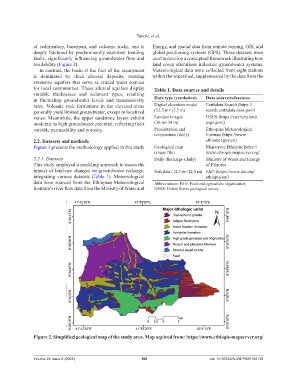
                of sedimentary, basement,  and volcanic  rocks, and  is   Energy, and spatial data from remote sensing, GIS, and
                deeply fractured by predominantly east-west trending   global positioning systems (GPS). These datasets were
                faults, significantly influencing groundwater flow and   used to develop a conceptual framework illustrating how
                availability (Figure 2).                            land cover alterations influence groundwater systems.
                  In contrast, the basin at the foot of the escarpment   Meteorological data were collected from eight stations
                is dominated  by thick  alluvial  deposits, forming   within the watershed, supplemented by the data from the
                extensive aquifers that serve as crucial water sources
                for local communities. These alluvial aquifers display   Table 1. Data sources and details
                variable  thicknesses and sediment  types, resulting
                in  fluctuating  groundwater  levels  and  transmissivity   Data type (resolution)  Data source/references
                rates.  Volcanic rock  formations  in  the  elevated  areas   Digital elevation model   Earthdata Search (https://
                generally yield limited groundwater, except in localized   (12.5 m×12.5 m)  search.earthdata.nasa.gov/)
                zones. Meanwhile, the upper sandstone layers exhibit   Landsat images       USGS (https://earthexplorer.
                moderate to high groundwater potential, reflecting their   (30 m×30 m)      usgs.gov/)
                variable permeability and porosity.                  Precipitation and      Ethiopian Meteorological
                                                                     temperature (daily)    Institute (https://www.
                2.2. Datasets and methods                                                   ethiomet.gov.et/)
                Figure 3 presents the methodology applied in this study  Geological map     Mapserver Ethiopia: https://
                                                                     (shape file)           www.ethiogis-mapserver.org/
                2.2.1. Datasets                                      Daily discharge (daily)  Ministry of Water and Energy
                This study employed a modeling approach to assess the                       of Ethiopia
                impact of land-use changes on groundwater recharge,   Soil data (12.5 m×12.5 m) FAO (https://www.fao.org/
                integrating various datasets (Table 1). Meteorological                      ethiopia/en/)
                data were sourced from the Ethiopian Meteorological   Abbreviations: FAO: Food and agriculture organization;
                Institute’s river flow data from the Ministry of Water and   USGS: United States geological survey.


                Figure 2. Simplified geological map of the study area. Map aquired from: https://www.ethiogis-mapserver.org/


                Volume 22 Issue 6 (2025)                       106                           doi: 10.36922/AJWEP025180139

