


Page 116 - AJWEP-22-6
P. 116
Takele, et al.

                soil type, slope, and land cover.  The HRUs were    Focusing on these critical  parameters enhanced the
                superimposed with soil and land cover data to model   model accuracy, ensuring alignment with observed data
                elementary hydrological processes such as runoff and   and improving its ability to simulate future hydrological
                infiltration. Weather data (air temperature and rainfall)   responses to changes in land use and climate. Detailed
                were employed to tune model performance. Soil data   descriptions of the parameters are available in the SWAT
                from National Agricultural institute were cross-checked   user manual for replication or further refinement. 43,44
                with the Food and Agriculture Organization soil map,   In this study, both manual and automated techniques
                and slope and elevation maps were produced from the   were employed using observed river flow data for SWAT
                DEM of the region.                                  model calibration. The combination of these approaches
                                                                    was chosen to ensure greater accuracy and reliability,
                2.2.7.1. Watershed delineation and hydrologic response units  as manual techniques allow for expert judgment, while
                Flow accumulation  and  direction  were  developed   automated  methods  enhance  efficiency  and  minimize
                using ArcSWAT with the  region’s DEM. These steps   human error. To allow the model to stabilize, the first
                                                                                13
                are crucial  for characterizing  the watershed.  This   2 years (2000 and 2001) were excluded as a warm-up
                study divided  the  watershed  into  30 sub-watersheds,   period,  following  established  hydrological  modeling
                facilitating  the detailed  visualization  of hydrological   practices.  Calibration was based on 2002–2007 data,
                                                                             41
                units  for the  simulation  of groundwater  recharge   while  validation used  2008–2014  data.  For manual
                employed  in  the  SWAT model.  The  land  use, soil,   calibration,  parameters were adjusted through trial
                and slope data were combined to define HRUs using   and error to enhance  the model  performance. 38,43  In
                thresholds of 20% for land use, 10% for soil, and 20% for   addition, the SUFI-2 method was employed to fine-tune
                slope-based slope distribution of the region. This unit is   parameters  within  defined  ranges,  thereby  improving
                one of the advances made by SWAT in simulating water   accuracy  through a robust statistical  approach. 17,45
                balances for watersheds. These HRUs were employed   To evaluate the model performance, metrics such as
                                                                      2
                to simulate hydrological processes (e.g., surface runoff   R , NSE, and PBIAS  were applied. Calibration  was
                and groundwater recharge) in the SWAT model.        accepted as successful if the mean flow difference was
                                                                    within ±15%, R  > 0.60, and NSE > 0.50, as previously
                                                                                  2
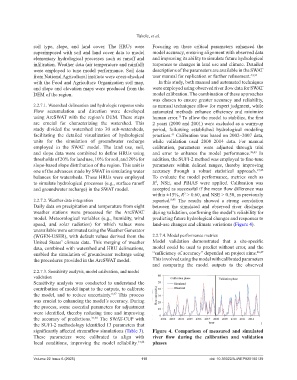
                2.2.7.2. Weather data integration                   reported. 8,45   The results showed a strong correlation
                Daily data on precipitation and temperature from eight   between  the  simulated  and observed river  discharge
                weather  stations were processed  for the  ArcSWAT   during validation, confirming the model’s reliability for
                model. Meteorological variables (e.g., humidity, wind   predicting future hydrological changes and responses to
                speed, and solar radiation)  for which values  were   land-use changes and climate variations (Figure 4).
                unavailable were estimated using the Weather Generator
                (WGEN-USER), with default values derived from the   2.2.7.4. Model performance metrics
                United States’ climate  data. This merging of weather   Model  validation  demonstrated  that  a  site-specific
                data, combined with watershed and HRU delineations,   model could be used to predict without error, and the
                enabled the simulation of groundwater recharge using   “sufficiency of accuracy” depended on project aims. 46,47
                the procedures provided in the ArcSWAT model.       This involved using the model with calibrated parameters
                                                                    and comparing the model outputs to the observed
                2.2.7.3. Sensitivity analysis, model calibration, and model
                validation
                Sensitivity  analysis was conducted  to  understand  the
                contribution of model input to the outputs, to calibrate
                the model, and to reduce uncertainty. 8,37  This  process
                was crucial to enhancing the model’s accuracy. During
                the process, some essential parameters for adjustment
                were identified, thereby reducing time and improving
                the accuracy of predictions. 37,38  The SWAT-CUP with
                the SUFI-2 methodology identified 13 parameters that
                significantly affected streamflow simulations (Table 3).   Figure  4. Comparison of measured and simulated
                These parameters were calibrated  to align with     river  flow  during  the  calibration  and  validation
                local  conditions, improving  the  model  reliability. 17,42    phases


                Volume 22 Issue 6 (2025)                       110                           doi: 10.36922/AJWEP025180139

