


Page 117 - AJWEP-22-6
P. 117
SWAT-based LULC impacts on groundwater recharge

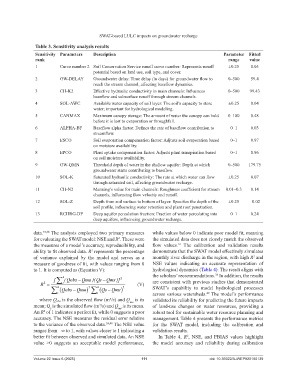
                 Table 3. Sensitivity analysis results
                 Sensitivity  Parameters  Description                                              Parameter  Fitted
                 rank                                                                                 range    value
                 1         Curve number 2 Soil Conservation Service runoff curve number: Represents runoff   ±0.25  0.05
                                          potential based on land use, soil type, and cover.
                 2         GW-DELAY       Groundwater delay: Time delay (in days) for groundwater flow to   0–500  59.4
                                          reach the stream channel, affecting baseflow dynamics.
                 3         CH-K2          Effective hydraulic conductivity in main channels: Influences   0–500  99.43
                                          baseflow and subsurface runoff through stream channels.
                 4         SOL-AWC        Available water capacity of soil layer: The soil’s capacity to store   ±0.25  0.04
                                          water; important for hydrological modeling.
                 5         CANMAX         Maximum canopy storage: The amount of water the canopy can hold   0–100  0.48
                                          before it is lost to evaporation or throughfall.
                 6         ALPHA-BF       Baseflow alpha factor: Defines the rate of baseflow contribution to   0–1  0.03
                                          streamflow.
                 7         ESCO           Soil evaporation compensation factor: Adjusts soil evaporation based   0–1  0.97
                                          on moisture availability.
                 8         EPCO           Plant uptake compensation factor: Adjusts plant transpiration based   0–1  0.96
                                          on soil moisture availability.
                 9         GW-QMN         Threshold depth of water in the shallow aquifer: Depth at which   0–500  179.75
                                          groundwater starts contributing to baseflow.
                 10        SOL-K          Saturated hydraulic conductivity: The rate at which water can flow   ±0.25  0.07
                                          through saturated soil, affecting groundwater recharge.
                 11        CH-N2          Manning’s value for main channels: Roughness coefficient for stream   0.01–0.3  0.14
                                          channels, influencing flow velocity and runoff.
                 12        SOL-Z          Depth from soil surface to bottom of layer: Specifies the depth of the   ±0.25  −0.02
                                          soil profile, influencing water retention and plant root penetration.
                 13        RCHRG-DP       Deep aquifer percolation fraction: Fraction of water percolating into   0–1  0.24
                                          deep aquifers, influencing groundwater recharge.


                data. 37,38  The analysis employed two primary measures   while values below 0 indicate poor model fit, meaning
                for evaluating the SWAT model: NSE and R . These were   the simulated data does not closely match the observed
                                                     2
                the measures of a model’s accuracy, reproducibility, and   flow  values.   The calibration  and validation results
                                                                               37
                ability to fit observed data. R  represents the percentage   demonstrate that the SWAT model effectively simulates
                                         2
                of variance explained by the model and serves as a   monthly river discharge in the region, with high R  and
                                                                                                                 2
                measure of goodness of fit, with values ranging from 0   NSE values indicating  an accurate  representation  of
                to 1. It is computed as (Equation V):               hydrological dynamics (Table 4). The result aligns with
                                                                    the scholars’ recommendations.  In addition, the results
                                                                                                38
                             n
                         [   ( Qobs QmoQs Qms  )(    )] 2        are consistent with previous studies that demonstrated
                    2
                   R        i                                (V)
                         n i  Qobs Qmo   2  n i  Qs Qms 2     SWAT’s capability  to model hydrological  processes

                                                                    across various watersheds.  The model’s performance
                                                                                            49
                  where Q obs  is the observed flow (m³/s) and Q  is its   validated its reliability for predicting the future impacts
                                                          mo
                mean; Q  is the simulated flow (m /s) and Q  is its mean.   of land-use changes on water resources, providing a
                                             3
                                                     ms
                       s
                An R  of 1 indicates a perfect fit, while 0 suggests a poor   robust tool for sustainable water resource planning and
                    2
                accuracy. The NSE measures the residual error relative   management. Table 4 presents the performance metrics
                to the variance of the observed data. 38,48  The NSE value   for the  SWAT model,  including  the  calibration  and
                ranges from −∞ to 1, with values closer to 1 indicating a   validation results.
                better fit between observed and simulated data. An NSE   In Table  4,  R , NSE, and PBIAS  values highlight
                                                                                   2
                value >0 suggests an acceptable model performance,   the  model  accuracy  and  reliability  during  calibration
                Volume 22 Issue 6 (2025)                       111                           doi: 10.36922/AJWEP025180139

