


Page 121 - AJWEP-22-6
P. 121
SWAT-based LULC impacts on groundwater recharge

                              A                                    B


                              C


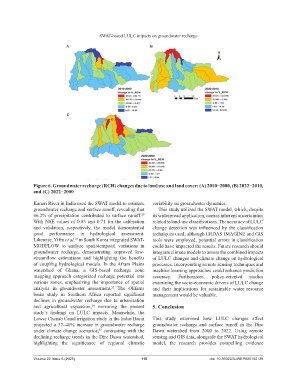
                Figure 6. Groundwater recharge (RCH) changes due to land use and land cover: (A) 2010−2000, (B) 2022−2010,
                and (C) 2022−2000

                Kanari River in India used the SWAT model to estimate   variability on groundwater dynamics.
                groundwater recharge and surface runoff, revealing that   This study utilized the SWAT model, which, despite
                46.2%  of  precipitation  contributed  to  surface  runoff.    its widespread application, carries inherent uncertainties
                                                               20
                With NSE values of 0.83 and 0.71 for the calibration   related to land-use classifications. The accuracy of LULC
                and validation, respectively, the model demonstrated   change  detection  was  influenced  by  the  classification
                good performance in hydrological assessment.        techniques used; although ERDAS IMAGINE and GIS
                Likewise, Yifru et al.  in South Korea integrated SWAT-  tools were employed, potential errors in classification
                                  18
                MODFLOW  to  analyze  spatiotemporal  variations  in   could have impacted the results. Future research should
                groundwater recharge, demonstrating improved low-   integrate climate models to assess the combined impacts
                streamflow  estimations  and  highlighting  the  benefits   of LULC changes and climate change on hydrological
                of coupling hydrological models. In the Afram Plains   processes. Incorporating remote sensing techniques and
                watershed of Ghana, a GIS-based recharge zone       machine learning approaches could enhance prediction
                mapping approach categorized recharge potential into   accuracy.  Furthermore,  policy-oriented  studies
                various zones, emphasizing the importance of spatial   examining the socio-economic drivers of LULC change
                analysis in groundwater assessment.  The  Olifants   and  their  implications  for sustainable  water  resource
                                                  52
                basin  study  in  Southern  Africa  reported  significant   management would be valuable.
                declines in groundwater recharge due to urbanization
                and agricultural expansion,  mirroring the present   5. Conclusion
                                         14
                study’s  findings  on  LULC  impacts.  Meanwhile,  the
                Lower Chenab Canal irrigation study in the Indus Basin   This  study  examined  how  LULC  changes  affect
                projected a 37–40% increase in groundwater recharge   groundwater  recharge  and  surface  runoff  in  the  Dire
                under climate change scenarios,  contrasting with the   Dawa watershed from 2000 to 2022. Using remote
                                             53
                declining recharge trends in the Dire Dawa watershed,   sensing and GIS data, alongside the SWAT hydrological
                highlighting  the  significance  of  regional  climatic   model,  the  research  provides  compelling  evidence


                Volume 22 Issue 6 (2025)                       115                           doi: 10.36922/AJWEP025180139

