


Page 142 - AJWEP-22-6
P. 142
Aleid, et al.
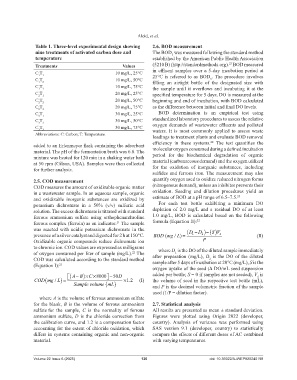
Table 1. Three‑level experimental design showing 2.6. BOD measurement
nine treatments of activated carbon dose and The BOD was measured following the standard method
5
temperature established by the American Public Health Association
23
Treatments Values (5210 B) (http://standardmethods.org). BOD measured
C T 10 mg/L, 25°C in effluent samples over a 5-day incubation period at
1 1 25°C is referred to as BOD . The procedure involves
C T 10 mg/L, 50°C 5
1 2 filling an airtight bottle of the designated size with
C T 10 mg/L, 75°C
1 3 the sample until it overflows and incubating it at the
C T 1 20 mg/L, 25°C specified temperature for 5 days. DO is measured at the
2
C T 2 20 mg/L, 50°C beginning and end of incubation, with BOD calculated
2
C T 3 20 mg/L, 75°C as the difference between initial and final DO levels.
2
C T 1 30 mg/L, 25°C BOD determination is an empirical test using
3
C T 2 30 mg/L, 50°C standardized laboratory procedures to assess the relative
3
C T 3 30 mg/L, 75°C oxygen demands of wastewater effluents and polluted
waters. It is most commonly applied to assess waste
3
Abbreviations: C: Carbon; T: Temperature.
loadings to treatment plants and evaluate BOD removal
efficiency in these systems. The test quantifies the
22
added to an Erlenmeyer flask containing the adsorbent
material. The pH of the fermentation broth was 6.8. The molecular oxygen consumed during a defined incubation
mixture was heated for 120 min in a shaking water bath period for the biochemical degradation of organic
at 50 rpm (Gilson, USA). Samples were then collected material (carbonaceous demand) and the oxygen utilized
for further analysis. for the oxidation of inorganic substances, including
sulfides and ferrous iron. The measurement may also
2.5. COD measurement quantify oxygen used to oxidize reduced nitrogen forms
COD measures the amount of oxidizable organic matter (nitrogenous demand), unless an inhibitor prevents their
in a wastewater sample. In an aqueous sample, organic oxidation. Seeding and dilution procedures yield an
and oxidizable inorganic substances are oxidized by estimate of BOD at a pH range of 6.5–7.5. 23
potassium dichromate in a 50% (v/v) sulfuric acid For each test bottle exhibiting a minimum DO
solution. The excess dichromate is titrated with standard depletion of 2.0 mg/L and a residual DO of at least
ferrous ammonium sulfate using orthophenanthroline 1.0 mg/L, BOD is calculated based on the following
ferrous complex (ferroin) as an indicator. The sample formula (Equation II): 22
21
was reacted with acidic potassium dichromate in the ( D − )−()
D
SV
presence of a silver catalyst and digested for 2 h at 150°C. BODmgL( / ) = 1 2 s (II)
Oxidizable organic compounds reduce dichromate ion P
to chromic ion. COD values are expressed as milligrams where D is the DO of the diluted sample immediately
of oxygen consumed per liter of sample (mg/L). The 1
22
COD was calculated according to the standard method after preparation (mg/L), D is the DO of the diluted
2
sample after 5 days of incubation at 20°C (mg/L), S is the
(Equation I): 21
oxygen uptake of the seed (Δ DO/mL seed suspension
C
S
(
CODmgL/ ) = ( AB− )××8000 − 50 D ×12 added per bottle; S = 0 if samples are not seeded), V is
. (I)
the volume of seed in the respective test bottle (mL),
(
SamplevolumemL) and P is the decimal volumetric fraction of the sample
used (1/P = dilution factor).
where A is the volume of ferrous ammonium sulfate
for the blank, B is the volume of ferrous ammonium 2.7. Statistical analysis
sulfate for the sample, C is the normality of ferrous All results are presented as mean ± standard deviation.
ammonium sulfate, D is the chloride correction from Figures were plotted using Origin 2022 (developer,
the calibration curve, and 1.2 is a compensation factor country). Analysis of variance was performed using
accounting for the extent of chloride oxidation, which SAS version 9.1 (developer, country) to statistically
differs in systems containing organic and non-organic compare the effects of different doses of AC combined
material. with varying temperatures.
Volume 22 Issue 6 (2025) 136 doi: 10.36922/AJWEP025240198

