


Page 143 - AJWEP-22-6
P. 143
Charcoal-adsorption of antibiotic fermentation broth

                3. Results and discussion                            Table 2. Physicochemical properties of the
                                                                     fermentation broth effluent
                3.1. Physicochemical properties                      Parameter                              Value
                The physicochemical  properties  of the  fermentation   Color                           Creamy yellow
                broth,  containing  organic  materials  and  cells  of
                S.  pristinaespiralis,  were  evaluated  (Table  2).  The   pH                            6.8±0.11
                broth was semi-transparent with a creamy-yellow color.   Total solids (g/L)               6.5±0.20
                The total solids and sugars were 6.5 g/L and 3.84 g/L,   Sugars (g/L)                     3.8±0.15
                respectively, while the concentrations of K , Na , Mg ,   Calcium ion (ppm)               560±5.46
                                                               2+
                                                     +
                                                          +
                and Ca  were 100, 150, 360, and 560 ppm, respectively.  Sodium ion (ppm)                  360±4.89
                      2+
                                                                     Potassium ion (ppm)                  150±2.33
                3.2. Effects of AC dose and temperature on organic
                materials                                            Magnesium ion (ppm)                  100±3.12
                Biopharmaceutical  wastewater  typically  exhibits   Zinc (II) ion (ppm)                  3.0±0.25
                high BOD  and COD  levels due to the presence of     Copper (II) ion (ppm)                0.1±0.001
                microorganisms and organic compounds. This section   Chromium (II) ion                    0.1±0.001
                discusses the application of different concentrations of   (ppm)
                AC at varying temperatures to reduce COD and BOD
                in pristinamycin  fermentation  broth.  The pH of the
                fermentation  broth  was  6.8.  However,  no  significant
                change  was  observed  in  the  pH  of  treated  effluents
                following  AC treatment  (data not shown). Neither
                increasing the AC dosage nor temperature significantly
                affected pH values. This may be attributed to the use of
                relatively low carbon concentrations, with the maximum
                being 30 mg/L.

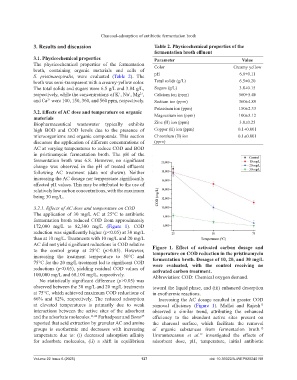
                3.2.1. Effects of AC dose and temperature on COD
                The application of 30 mg/L AC at 25°C to antibiotic
                fermentation broth reduced COD from approximately
                172,000  mg/L to 82,300  mg/L (Figure  1). COD
                reduction was significantly higher (p<0.05) at 30 mg/L
                than at 10 mg/L. Treatments with 10 mg/L and 20 mg/L
                AC did not yield significant reductions in COD relative   Figure  1.  Effect  of  activated  carbon  dosage  and
                to the control  group at  25°C (p˃0.05).  However,   temperature on COD reduction in the pristinamycin
                increasing  the treatment  temperature  to 50°C and   fermentation broth. Dosages of 10, 20, and 30 mg/L
                75°C for the 20 mg/L treatment led to significant COD   were  evaluated,  with  the  control  receiving  no
                reductions (p<0.05), yielding residual COD values of   activated carbon treatment.
                100,000 mg/L and 68,100 mg/L, respectively.         Abbreviation: COD: Chemical oxygen demand.
                  No  statistically  significant  difference  (p>0.05)  was
                observed between the 30 mg/L and 20 mg/L treatments   toward the liquid phase, and (iii) enhanced desorption
                at 75°C, which achieved maximum COD reductions of   in exothermic reactions.
                66% and 62%, respectively.  The  reduced  adsorption   Increasing the AC dosage resulted in greater COD
                at elevated  temperatures  is primarily  due to weak   removal  efficiency  (Figure  1). Mullai and Rajesh
                                                                                                                    15
                interactions  between  the  active  sites  of  the  adsorbent   observed a similar trend, attributing  the enhanced
                and the adsorbate molecules. 11,24  Farhadpour and Bono    efficiency  to  the  abundant  active  sites  present  on
                                                               25
                reported that acid extraction by granular AC and amine   the  charcoal  surface,  which  facilitate  the  removal
                groups is exothermic  and decreases with increasing   of organic  substances  from fermentation  broth.
                                                                                                                    15
                temperature  due  to:  (i)  decreased  adsorption  affinity   Umrantezcanun  et  al.   investigated  the  effects  of
                                                                                         12
                for adsorbate  molecules,  (ii) a shift in equilibrium   adsorbent  dose,  pH, temperature,  initial  antibiotic


                Volume 22 Issue 6 (2025)                       137                           doi: 10.36922/AJWEP025240198

