


Page 144 - AJWEP-22-6
P. 144
Aleid, et al.

                concentration,  and agitation  duration  on TC removal.   The  most  significant  decrease  in  BOD  occurred
                                                                                                           5
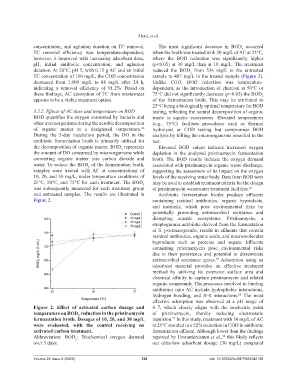
                TC  removal  efficiency  was  temperature-dependent;   when the broth was treated with 30 mg/L of AC at 25°C,
                however, it improved with increasing adsorbent dose,   where  the  BOD  reduction  was  significantly  higher
                pH, initial  antibiotic  concentration,  and agitation   (p<0.05)  at  30  mg/L  than  at  10  mg/L. The  treatment
                duration. At 20°C, pH 5, with 0.15 g AC and an initial   reduced the BOD  from 536  mg/L in the untreated
                                                                                     5
                TC concentration of 100 mg/L, the COD concentration   sample to 487 mg/L in the treated sample (Figure 2).
                decreased  from 1,000  mg/L to 88  mg/L after  24  h,   Unlike COD, BOD  reduction was  temperature-
                indicating  a  removal  efficiency  of  91.2%.  Based  on   dependent, as the introduction of charcoal at 50°C or
                these findings, AC adsorption of TC from wastewater   75°C did not significantly decrease (p˃0.05) the BOD
                                                                                                                    5
                appears to be a viable treatment option.            of the fermentation  broth.  This may be attributed  to
                                                                    25°C being a biologically optimal temperature for BOD
                3.2.2. Effects of AC dose and temperature on BOD    testing, reflecting the natural decomposition of organic
                BOD quantifies the oxygen consumed by bacteria and   waste in aquatic ecosystems. Elevated  temperatures
                other microorganisms during the aerobic decomposition   (e.g., 75°C) facilitate  procedures such as thermal
                of organic matter  at a designated temperature.     hydrolysis or COD testing  but compromise  BOD
                                                               26
                During  the  5-day  incubation  period,  the  DO in  the   analysis by killing the microorganisms essential to the
                antibiotic  fermentation  broth  is  primarily  utilized  for   test.
                the decomposition of organic matter. BOD  represents   Elevated  BOD values indicate increased  oxygen
                                                      5
                the amount of DO consumed by microorganisms while   depletion  in  the  analyzed  pristinamycin  fermentation
                converting  organic  matter  into  carbon  dioxide  and   broth.  The  BOD results  indicate  the  oxygen  demand
                water. To reduce the BOD  of the fermentation broth,   associated with pristinamycin organic waste discharge,
                                        5
                samples were treated  with  AC at concentrations  of   supporting the assessment of its impact on the oxygen
                10, 20, and 30 mg/L, under temperature conditions of   levels of the receiving water body. Data from BOD tests
                25°C, 50°C, and 75°C for each treatment. The BOD    may be used to establish treatment criteria for the design
                                                                5
                was subsequently measured for each treatment  group   of pristinamycin wastewater treatment facilities. 22
                and untreated  samples.  The results are illustrated  in   Antibiotic  fermentation  broths  produce  effluents
                Figure 2.                                           containing  residual  antibiotics,  organic  byproducts,
                                                                    and  nutrients, which  pose environmental  risks by
                                                                    potentially  promoting antimicrobial  resistance and
                                                                    disrupting  aquatic  ecosystems.  Pristinamycin,  a
                                                                    streptogramin antibiotic derived from the fermentation
                                                                    of S. pristinaespiralis, results in effluents that contain
                                                                    residual antibiotics, organic acids, and macromolecular
                                                                    byproducts  such  as  proteins  and  sugars.  Effluents
                                                                    containing  pristinamycin  pose environmental  risks
                                                                    due to their  persistence  and potential  to disseminate
                                                                    antimicrobial  resistance genes.  Adsorption using an
                                                                                                27
                                                                    adsorbent  material  provides  an  effective  treatment
                                                                    method  by  utilizing  its  extensive  surface  area  and
                                                                    chemical affinity to capture pristinamycin and related
                                                                    organic compounds. The processes involved in binding
                                                                    antibiotics onto AC include hydrophobic interactions,
                                                                    hydrogen bonding, and  π–π interactions.  The  most
                                                                                                          28
                                                                    effective  adsorption  was  observed  at  a  pH  range  of
                Figure  2.  Effect  of  activated  carbon  dosage  and   6–7,  which  closely  aligns  with  the  isoelectric  point
                temperature on BOD  reduction in the pristinamycin   of pristinamycin,  thereby reducing electrostatic
                                   5
                fermentation broth. Dosages of 10, 20, and 30 mg/L   repulsion.  In this study, treatment with 30 mg/L of AC
                                                                             27
                were  evaluated,  with  the  control  receiving  no   at 25°C resulted in a 52% reduction in COD in antibiotic
                activated carbon treatment.                         fermentation effluent. Although lower than the findings
                Abbreviation:  BOD : Biochemical  oxygen demand     reported by Umrantezcanun et al.,  this likely reflects
                                                                                                   12
                                  5
                over 5 days.                                        our  ultra-low  adsorbent  dosage  (30  mg/L)  compared


                Volume 22 Issue 6 (2025)                       138                           doi: 10.36922/AJWEP025240198

