


Page 46 - AN-2-2
P. 46
Advanced Neurology                                                                  Seizures and CKD


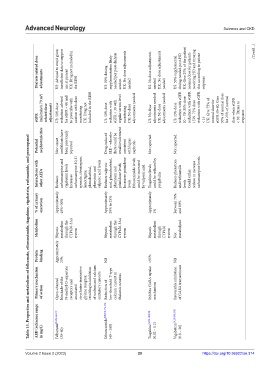
                 Dialysis‑related dose   adjustments  US: Advised to avoid given   insufficient data to support   use at present  UK: Drug not included in   the RDH  US: 50% dosing   supplementation likely   needed per post-dialysis   session  UK: No dose adjustments   needed  US: No dose adjustments   needed  UK: No dose adjustments   needed  US: 50% supplemental   dosing needed post-HD UK: Give 25% of the patient   normal dose for patients   receiving HD and titrating


                   (mL/min/1.73 m 2 )   reduction advised   for eGFR < 60 and   to prescribe with   caution with close   included in the RDH  reduction with   eGFR < 30 with   regular serum level   adjustments needed  adjustments needed  adjustments needed  reduction with eGFR   30 – 59. 50% dose   reduction with eGFR   1529. 75% dose   reduction with eGFR   UK: Give 75% of   normal dose for   eGFR 50–80. Give   50% of normal dose   for 25% of normal  dose when eGFR   < 3


                 eGFR   related dose   adjustments  US: 50% dose   monitoring.  UK: Drug not   US: 50% dose   monitoring  UK: No dose   US: No dose   UK: No dose   US: 25% dose   < 15  response.


             Table 15. Properties and metabolism of felbamate, ethosuximide, tiagabine, vigabatrin, rufinamide, and perampanel
                 Potential   nephrotoxicities  New-onset   urolithiasis have   been previously   reported  Drug-induced   SLE – whereby   there could be   renal involvement   consistent   with lupus   nephritis   Not reported  Not reported


                 Interactions with   other AEDs  Reduces   carbamazepine and   vigabatrin levels  Increases   carbamazepine-10,11   epoxide, clonazepam,   lamotrigine,   phenobarbital,   phenytoin and   valproic acid levels  Reduces valproic   acid, phenobarbital,   phenytoin and   primidone levels  Increases primidone   levels  Ethosuximide levels   could be increased   by valproic acid  Tiagabine levels   could be reduced by   pregabalin   Reduces phenytoin   and rufina


                 % of urinary   excretion  Approximately   40%–50%  Approximately   20% to 25%  Approximately   1%  Between 70%   and 80%


                 Metabolism  Hepatic   metabolism   through the   CYP450-3A4   system  Hepatic   metabolism   through the   CYP450-3A4   system  Hepatic   metabolism   through   CYP450   system  Not   metabolized


                 Protein   binding  Approximately   25%  Nil     >95%       Nil


                 Primary mechanism   of action  Open-channel   blockade of the   N-methyl-D-aspartate   receptors and   associated   strychnine-insensitive   glycine receptor,   resulting in inhibition   of sodium and calcium   excitatory currents  Reduction of   low-threshold T-type   calcium current in   thalamic neurons  Inhibits GABA uptake   mechanism  Irreversible inhibition   of GABA transaminase


                 AED (reference range   in mg/L)  Felbamate [9,129,169-171]  (30–60)  Ethosuximide [130,131,172-174]  (40 – 100)  Tiagabine [9,129,130,175]  (0.02 – 0.2)  Vigabatrin [9,129,130,176]  (0.8 – 36)


                                                            20
                                                                                       https://doi.org/10.36922/an.314
            Volume 2 Issue 2 (2023) olume 2 Issue 2 (2023)
            V                                               20                         https://doi.org/10.36922/an.314

