


Page 44 - AN-2-2
P. 44
Advanced Neurology                                                                  Seizures and CKD


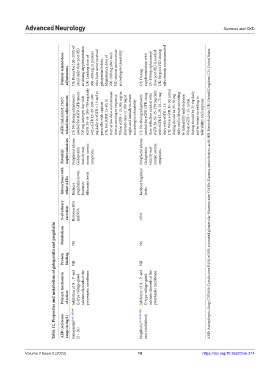
                            Dialysis‑related dose   adjustments  US: Prescribe 100–200% of   usual daily dose post-HD   as dosing supplementation  UK: Loading dose of   300–400 mg in patients   who have never received  gabapentin before.   Maintenance dose of  200–300 mg after each   HD session and increase   according to tolerability.  US: Dosing   supplementation with   25–150mg replacement   dose post-HD is needed  UK: No post-HD dosing  adjustments recommended


                            eGFR (mL/min/1.73m 2 )   related dose adjustments  US: No dosing adjustments  needed for eGFR GFR tment–  700 mg twice per day with  eGFR 30–59. 200–700 mg daily   with eGFR 15–29. 100–300  mg daily in eGFR < 15 and to   prescribe with caution  UK: For eGFR 15–60, to  start at low dose and increase   dose according to response.  When eGFR < 15, 300 mg on   alternate days or 100 mg at   night, and initially increase   according to tolerability


                            Potential   nephrotoxicities  Peripheral edema  Gabapentin   toxicity may   mimic uremic   symptoms  Peripheral edema  Gabapentin   toxicity may   mimic uremic   symptoms


                            Interactions with   other AEDs  Reduces   pregabalin levels  Increases   felbamate levels  Reduces tiagabine   levels  AED: Antiepileptic drug; CYP450: Cytochrome P450; eGFR: estimated glomerular filtration rate; GABA: Gamma-aminobutyric acid; HD: Hemodialysis; UK: United Kingdom; US: United States.


                            % of urinary   excretion  Between 80%   and 95%  >95%


                        Table 12. Properties and metabolism of gabapentin and pregabalin
                            Metabolism  Nil                  Nil


                            Protein   binding  Nil           Nil


                            Primary mechanism   of action  Inhibition of N-, P- and   Q-type voltage-gated   calcium channels at the   presynaptic membrane.  Inhibition of N-, P- and   Q-type voltage-gated   calcium channels at the   presynaptic membrane.


                            AED (reference   range in mg/L)  Gabapentin [9,131,135,166]  (2 – 20)  Pregabalin [9,130,131,135]  (not established)


                                                            18
                                                                                       https://doi.org/10.36922/an.314
            V                                               18                         https://doi.org/10.36922/an.314
            Volume 2 Issue 2 (2023) olume 2 Issue 2 (2023)

