


Page 68 - AN-2-4
P. 68
Advanced Neurology                                               A novel marker for healthy intracranial arteries


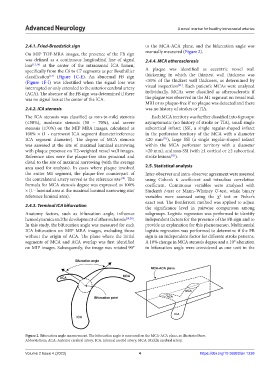
            2.4.1. Fried-Breadstick sign                       to the MCA-ACA plane, and the bifurcation angle was

            On MIP TOF-MRA images, the presence of the FB sign   manually measured (Figure 2).
            was defined as a continuous longitudinal line of signal   2.4.4. MCA atherosclerosis
            loss [12,16]  at the center of the intracranial ICA lumen,
            specifically from the C6 to C7 segments as per Bouthillier   A  plaque  was  identified  as  eccentric  vessel  wall
            classification  (Figure  1C-E). An abnormal FB sign   thickening in which the thinnest wall thickness was
                      [17]
            (Figure  1F-I) was identified when the signal loss was   <50%  of  the  thickest wall  thickness, as determined by
                                                                             [21]
            interrupted or only extended to the anterior cerebral artery   visual inspection . Each patient’s MCAs were analyzed
            (ACA). The absence of the FB sign was determined if there   individually. MCAs were classified as atherosclerotic if
            was no signal loss at the center of the ICA.       the plague was observed in the M1 segment on vessel wall
                                                               MRI or as plaque-free if no plaque was detected and there
            2.4.2. ICA stenosis                                was no history of strokes or TIA.
            The ICA stenosis was classified as non-to-mild stenosis   Each MCA territory was further classified into 4 groups:
            (≤50%), moderate stenosis (50 – 70%), and severe   asymptomatic (no history of stroke or TIA), small single
            stenosis (≥70%) on the MIP MRA images, calculated as   subcortical infarct (SSI, a single regular-shaped infarct
            100% × (1  -  narrowest ICA segment diameter/reference   in the perforator territory of the MCA with a diameter
            ICA segment diameter). The degree of MCA stenosis   ≤20  mm ), large SSI (a single regular-shaped infarct
                                                                      [22]
            was assessed at the site of maximal luminal narrowing   within the MCA perforator territory with a diameter
            with plaque presence on T2-weighted vessel wall images.   >20 mm), and non-SSI (with ≥1 cortical or ≥2 subcortical
            Reference sites were the plaque-free sites proximal and   stroke lesions ).
                                                                          [23]
            distal to the site of maximal narrowing (with the average
            area used for analysis). In cases where plaque involved   2.5. Statistical analysis
            the entire M1 segment, the plaque-free counterpart of   Inter-observer and intra-observer agreement were assessed
            the contralateral artery served as the reference site . The   using Cohen’s  κ coefficient and intraclass correlation
                                                    [18]
            formula for MCA stenosis degree was expressed as 100%   coefficient. Continuous variables were analyzed with
            × (1 - luminal area at the maximal luminal narrowing site/  Student’s  t-test  or  Mann–Whitney  U-test,  while  binary
            reference luminal area).                           variables were assessed using the  χ  test or Fisher’s
                                                                                               2
                                                               exact test. The Bonferroni method was applied to adjust
            2.4.3. Terminal ICA bifurcation                    the significance  level  in pairwise comparison  among
            Anatomy factors, such as bifurcation angle, influence   subgroups. Logistic regression was performed to identify
            hemodynamics and the development of atherosclerosis [19,20] .   independent factors for the presence of the FB sign and to
            In this study, the bifurcation angle was measured for each   provide an explanation for this phenomenon. Multinomial
            ICA  bifurcation  on  MIP  MRA  images,  excluding  those   logistic regression was performed to determine if the FB
            without the origin of ACA. The plane where the initial   sign is an independent factor for different stroke patterns.
            segments of MCA and ACA overlap was first identified   A 10% change in MCA stenosis degree and a 10° alteration
            on MIP images. Subsequently, the image was rotated 90°   in bifurcation angle were considered as one unit in the


            Figure 2. Bifurcation angle measurement. The bifurcation angle is measured on the MCA-ACA plane, as illustrated here.
            Abbreviations: ACA: Anterior cerebral artery; ICA: Internal carotid artery; MCA: Middle cerebral artery.

            Volume 2 Issue 4 (2023)                         4                         https://doi.org/10.36922/an.1238

