


Page 133 - AN-3-3
P. 133
Advanced Neurology                                            Delayed occlusion after mechanical thrombectomy


            significant medical history and was not on any medication.   after admission. During outpatient follow-ups with
            Neurological examination showed mild left facial paresis   regular MRI scans, a follow-up MRI at 3-month post-
            and left upper limb weakness. His National Institutes   onset revealed no ischemic lesion but showed occlusion
            of Health Stroke Scale score was 2 points at admission,   of the right MCA compared to the MRI at 1-month post-
            and his symptoms were unstable. An emergent magnetic   onset (Figure 2A: Immediate post-onset; Figure 2B: One-
            resonance imaging (MRI) revealed no apparent diffusion-  month post-onset;  Figure  2C: Three-month post-onset).
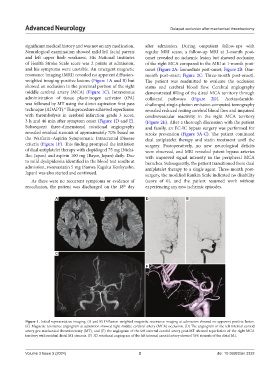
            weighted imaging-positive lesions (Figure 1A and B) but   The  patient  was  readmitted  to  evaluate  the  occlusion
            showed an occlusion in the proximal portion of the right   status and cerebral blood flow. Cerebral angiography
            middle cerebral artery (MCA) (Figure  1C). Intravenous   demonstrated filling of the distal MCA territory through
            administration of tissue plasminogen activator (tPA)   collateral pathways (Figure  2D). Acetazolamide-
            was followed by MT using the direct aspiration first pass   challenged single-photon emission computed tomography
            technique (ADAPT).  This procedure achieved reperfusion   revealed reduced resting cerebral blood flow and impaired
                            6
            with thrombolysis in cerebral infarction grade  3 score,   cerebrovascular reactivity in the right MCA territory
            3 h and 46 min after symptom onset (Figure 1D and E).   (Figure 2E). After a thorough discussion with the patient
            Subsequent three-dimensional rotational angiography   and family, an EC-IC bypass surgery was performed for
            revealed residual stenosis of approximately 70% based on   stroke prevention (Figure  3A-C). The patient continued
            the Warfarin–Aspirin Symptomatic Intracranial Disease   dual antiplatelet therapy and statin treatment until the
            criteria (Figure 1F). This finding prompted the initiation   surgery. Postoperatively, no new neurological deficits
            of dual antiplatelet therapy with clopidogrel 75 mg (Nichi-  were observed, and MRI  revealed patent bypass arteries
            Iko, Japan) and aspirin 100 mg (Bayer, Japan) daily. Due   with improved signal intensity in the peripheral MCA
            to mild dyslipidemia identified in the blood test results at   branches. Subsequently, the patient transitioned from dual
            admission, rosuvastatin 5 mg (Sanwa Kagaku Kenkyusho,   antiplatelet therapy to a single agent. Three-month post-
            Japan) was also started and continued.             surgery, the modified Rankin Scale indicated no disability
              As there were no recurrent symptoms or evidence of   (score of 0), and the patient resumed work without
            reocclusion,  the  patient  was  discharged  on  the  18   day   experiencing any new ischemic episodes.
                                                      th
                         A                  B                  D                E


                         C

                                                               F


            Figure 1. Initial representative imaging. (A and B) Diffusion-weighted magnetic resonance imaging at admission showed no apparent positive lesion.
            (C) Magnetic resonance angiogram at admission showed right middle cerebral artery (MCA) occlusion. (D) The angiogram of the left internal carotid
            artery pre-mechanical thrombectomy (MT), and (E) the angiogram of the left internal carotid artery post-MT showed reperfusion of the right MCA
            territory with residual distal M1 stenosis. (F) 3D rotational angiogram of the left internal carotid artery showed 70% stenosis of the distal M1.


            Volume 3 Issue 3 (2024)                         2                                doi: 10.36922/an.3332

