


Page 138 - AN-3-3
P. 138
Advanced Neurology                                                  Rare manifestation in nemaline myopathy


            Z  disc  through  its  C-terminus,  thereby  ensuring  the   A            B
            structural integrity of the thin filaments.  Primarily
                                                 3
            inherited through autosomal recessive and autosomal
            dominant modes, nemaline myopathy typically progresses
            slowly and exhibits heterogeneous clinical manifestations.
            It  is characterized  by limb or  axial  muscle  weakness
            typically appearing from the neonatal or preschool period,
            often accompanied by hypotonia, and involvement of
                                4
            facial muscles and joints.  Despite the broad spectrum of
            clinical phenotypes, the clinical presentation characterized
            by pyramidal tract involvement along with oligospermia
            has not been reported.
              This case report describes a 35-year-old Chinese male
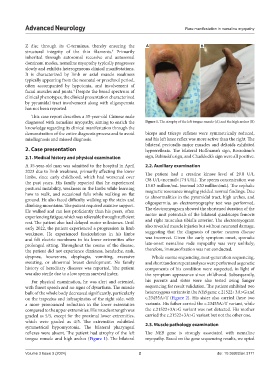
            diagnosed with nemaline myopathy, aiming to enrich the   Figure 1. The atrophy of the left tongue muscle (A) and the high arches (B)
            knowledge regarding its clinical manifestation through the
            demonstration of the entire diagnosis process and to avoid   biceps and triceps reflexes were symmetrically reduced,
            misdiagnosis and missed diagnosis.                 and his left knee reflex was more active than the right. The
                                                               bilateral pectoralis major muscles and deltoids exhibited
            2. Case presentation                               hyperreflexia.  The  bilateral  Hoffmann’s  sign,  Rossolimo’s
            2.1. Medical history and physical examination      sign, Babinski’s sign, and Chaddock’s sign were all positive.
            A 35-year-old man was admitted to the hospital in April   2.2. Auxiliary examination
            2023 due to limb weakness, primarily affecting the lower   The patient had a creatine kinase level of 29.0 U/L
            limbs,  since  early  childhood,  which  had  worsened  over   (38 U/L<normal<174 U/L). The sperm concentration was
            the past years. His family reported that he experienced   13.63 million/mL (normal ≥20 million/mL). The cephalic
            postural instability, weakness in the limbs while learning   magnetic resonance imaging yielded normal findings. Due
            how to walk, and occasional falls while walking on flat   to abnormalities in the pyramidal tract, high arches, and
            ground. He also faced difficulty walking up the stairs and   oligospermia, an electromyography test was performed.
            climbing mountains. The patient required assistive support.
            He walked and ran less proficiently than his peers, often   The electromyogram showed the shortened duration of the
            experiencing fatigue, which was relievable through sufficient   motor unit potentials of the bilateral quadriceps femoris
            rest. The patient also had delayed motor milestones. Until   and right musculus tibialis anterior. The electromyogram
            early 2022, the patient experienced a progression in limb   also revealed muscle injuries but without neuronal damage,
            weakness. He experienced fasciculations in his limbs   suggesting that the diagnosis of motor neuron disease
            and felt electric numbness in his lower extremities  after   was incorrect. Given the early symptom onset, sporadic
            prolonged sitting. Throughout the course of the disease,   late-onset nemaline rode myopathy was very unlikely;
            the patient did not experience dizziness, headache, rash,   therefore, immunofixation was not conducted.
            dyspnea,  hoarseness,  dysphagia, vomiting, excessive   Whole exome sequencing, next-generation sequencing,
            sweating, or abnormal breast development. No family   and short tandem repeat analyses were performed as genetic
            history of hereditary diseases was reported. The patient   components of his condition were suspected, in light of
            was also sterile due to a low sperm survival index.  the symptom appearance since childhood. Subsequently,
              For  physical  examination,  he  was  alert  and  oriented,   his parents and sister were also tested using Sanger
            with fluent speech and no signs of dysarthria. The muscle   sequencing for result validation. The patient exhibited two
            bulk of the whole body decreased significantly, particularly   heterozygous variants in the NEB gene: c.21522+3A>G and
            on the trapezius and infraspinatus of the right side, with   c.23455A>T (Figure 2). His sister also carried these two
            a more pronounced reduction in the lower  extremities   variants. His father carried the c.23455A>T variant, while
            compared to the upper extremities. His muscle strength was   the c.21522+3A>G variant was not detected. His mother
            graded as 5/5, except for the proximal lower extremities,   carried the c.21522+3A>G variant but not the other one.
            which  were  graded  as  4/5.  The  extremities  exhibited   2.3. Muscle pathology examination
            symmetrical hypomyotonia. The bilateral pharyngeal
            reflexes were absent. The patient had atrophy of the left   The  NEB gene is strongly associated with nemaline
            tongue muscle and high arches (Figure  1). The bilateral   myopathy. Based on the gene sequencing results, we opted


            Volume 3 Issue 3 (2024)                         2                                doi: 10.36922/an.3171

