


Page 134 - AN-3-3
P. 134
Advanced Neurology                                            Delayed occlusion after mechanical thrombectomy


            A                      B                      C                     D


            E


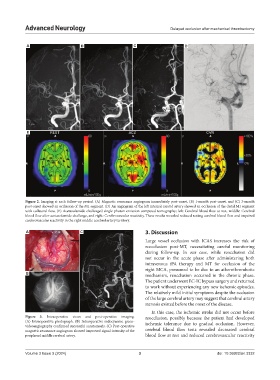
            Figure 2. Imaging at each follow-up period. (A) Magnetic resonance angiogram immediately post-onset, (B) 1-month post-onset, and (C) 3-month
            post-onset showed an occlusion of the M1 segment. (D) An angiogram of the left internal carotid artery showed an occlusion of the distal M1 segment
            with collateral flow. (E) Acetazolamide-challenged single photon emission computed tomography; left: Cerebral blood flow at rest, middle: Cerebral
            blood flow after acetazolamide challenge, and right: Cerebrovascular reactivity. These results revealed reduced resting cerebral blood flow and impaired
            cerebrovascular reactivity in the right middle cerebral artery territory.

            A                      C                           3. Discussion
                                                               Large vessel occlusion with ICAS increases the risk of
                                                               reocclusion post-MT, necessitating careful monitoring
                                                               during  follow-up.  In  our  case,  while  reocclusion  did
                                                               not occur in the acute phase after administering both
                                                               intravenous tPA therapy and MT for occlusion of the
                                                               right MCA, presumed to be due to an atherothrombotic
            B                                                  mechanism,  reocclusion occurred  in the  chronic  phase.
                                                               The patient underwent EC-IC bypass surgery and returned
                                                               to work without experiencing any new ischemic episodes.
                                                               The relatively mild initial symptoms despite the occlusion
                                                               of the large cerebral artery may suggest that cerebral artery
                                                               stenosis existed before the onset of the disease.
                                                                 In this case, the ischemic stroke did not occur before
            Figure  3. Intraoperative views and post-operative imaging.    reocclusion, possibly because the patient had developed
            (A) Intraoperative photograph. (B) Intraoperative indocyanine green-  ischemic tolerance due to gradual occlusion. However,
            videoangiography confirmed successful anastomosis. (C) Post-operative
            magnetic resonance angiogram showed improved signal intensity of the   cerebral blood flow tests revealed decreased cerebral
            peripheral middle cerebral artery.                 blood flow at rest and reduced cerebrovascular reactivity


            Volume 3 Issue 3 (2024)                         3                                doi: 10.36922/an.3332

