


Page 139 - AN-3-3
P. 139
Advanced Neurology                                                  Rare manifestation in nemaline myopathy


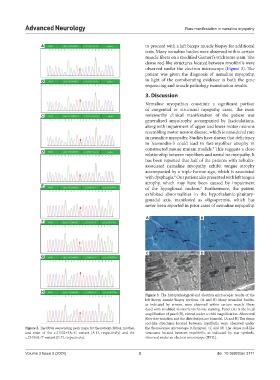
                   A                                           to proceed with a left biceps muscle biopsy for additional
                                                               tests. Many nemaline bodies were observed within certain
                                                               muscle fibers on a modified Gomori’s trichrome stain. The
                                                               dense rod-like structures located between myofibrils were
                                                               observed under the electron microscope (Figure 3). The
                                                               patient was given the diagnosis of nemaline myopathy,
                   B                                           in light of the corroborating evidence in both the gene
                                                               sequencing and muscle pathology examination results.
                                                               3. Discussion

                                                               Nemaline myopathies constitute a significant portion
                                                               of  congenital  or  structural  myopathy  cases.  The  most
                   C                                           noteworthy clinical manifestation of the patient was
                                                               generalized amyotrophy accompanied by fasciculations,
                                                               along with impairment of upper and lower motor neurons
                                                               resembling motor neuron disease, which is considered rare
                                                               in nemaline myopathy. Studies have shown that deficiency
                                                               in leiomodin-3 could lead to fast-myofiber atrophy in
                                                               constructed mouse mutant models.  This suggests a close
                                                                                           5
                   D
                                                               relationship between myofibers and nemaline myopathy. It
                                                               has been reported that half of the patients with nebulin-
                                                               associated nemaline myopathy exhibit tongue atrophy
                                                               accompanied by a triple furrow sign, which is associated
                                                               with dysphagia.  Our patient also presented with left tongue
                                                                           6
                                                               atrophy, which may have been caused by impairment
                   E
                                                               of the hypoglossal nucleus.  Furthermore, the patient
                                                                                      6
                                                               exhibited abnormalities in the hypothalamic-pituitary-
                                                               gonadal axis, manifested as oligospermia, which has
                                                               never been reported in prior cases of nemaline myopathy.

                                                               A                      B
                   F


                                                               C                      D
                   G


                   H
                                                               Figure 3. The histopathological and electron microscopic results of the
                                                               left biceps muscle biopsy sections. (A and B) Many nemaline bodies,
                                                               as indicated by arrows, were observed within certain muscle fibers
                                                               dyed with modified Gomori’s trichrome staining. Panel (A) is the local
                                                               amplification of panel (B), viewed under a ×400 magnification. Abnormal
                                                               fiber size variation and the distribution are bimodal. (A and B) The dense
                                                               rod-like structures located between myofibrils were observed under
            Figure 2. The DNA sequencing peak maps for the patient, father, mother,   the fluorescence microscope (Olympus). (C and D) The dense rod-like
            and sister of the c.21522+3A>G variant (A-D, respectively) and the   structures located between myofibrils, as indicated by star symbols,
            c.23455A>T variant (E-H, respectively).            observed under an electron microscope (JEOL).


            Volume 3 Issue 3 (2024)                         3                                doi: 10.36922/an.3171

