


Page 28 - AN-3-3
P. 28
Advanced Neurology                                                           Tau pathology in murine TBI


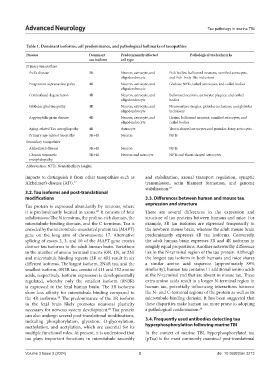
            Table 1. Dominant isoforms, cell predominance, and pathological hallmarks of tauopathies
            Disease                    Dominant     Predominantly affected        Pathological tau hallmarks
                                       tau isoform  cell type
            Primary tauopathies
             Pick’s disease            3R           Neuron, astrocyte, and   Pick bodies, ballooned neurons, ramified astrocytes,
                                                    oligodendrocyte      and Pick-body-like inclusions
             Progressive supranuclear palsy  4R     Neuron, astrocyte, and   Globose NFTs, tufted astrocytes, and coiled bodies
                                                    oligodendrocyte
             Corticobasal degeneration  4R          Neuron, astrocyte, and   Ballooned neurons, astrocytic plaques, and coiled
                                                    oligodendrocyte      bodies
             Globular glial tauopathy  4R           Neuron, astrocyte, and   Neuronal pre-tangles, globular inclusions, and globular
                                                    oligodendrocyte      inclusions
             Argyrophilic grain disease  4R         Neuron, astrocyte, and   Grains, ballooned neurons, ramified astrocytes, and
                                                    oligodendrocyte      coiled bodies
             Aging-related Tau astrogliopathy  4R   Astrocyte            Thorn-shaped astrocytes and granular-fuzzy astrocytes
             Primary age-related tauopathy  3R+4R   Neuron               NFTs
            Secondary tauopathies
             Alzheimer’s disease       3R+4R        Neuron               NFTs
             Chronic traumatic         3R+4R        Neuron and astrocyte  NFTs and thorn-shaped astrocytes
             encephalopathy
            Abbreviation: NFTs: Neurofibrillary tangles.
            impacts to distinguish it from other tauopathies such as   and  stabilization,  axonal  transport  regulation,  synaptic
            Alzheimer’s disease (AD). 27                       transmission, actin filament formation, and genome
                                                               stabilization. 24
            3.2. Tau isoforms and post-translational
            modifications                                      3.3. Differences between human and mouse tau
            Tau protein is expressed abundantly by neurons, where   expression and structure
            it is predominantly located in axons.  It consists of four   There are several differences in the expression and
                                          22
            subdivisions: The N terminus, the proline-rich domain, the   structure of tau proteins between humans and mice. For
            microtubule-binding domain, and the C terminus. Tau is   example,  3R  tau  isoforms  are  expressed  temporarily  in
            encoded by the microtubule-associated protein tau (MAPT)   the newborn mouse brain, whereas the adult mouse brain
            gene on the long arm of chromosome 17. Alternative   predominantly expresses 4R tau isoforms. Conversely,
            splicing of exons 2, 3, and 10 of the MAPT gene creates   the adult human brain expresses 3R and 4R isoforms in
            distinct tau isoforms in the adult human brain. Variations   roughly equal proportions. Another noteworthy difference
            in the number of amino terminal inserts (0N, 1N, or 2N)   lies in the N-terminal region of the tau protein. Although
            and microtubule binding repeats (3R or 4R) result in six   the longest tau isoform in both humans and mice shares
            different isoforms. The largest isoform, 2N4R tau, and the   a similar amino acid sequence (approximately 89%
            smallest isoform, 0N3R tau, consist of 411 and 352 amino   similarity), human tau contains 11 additional amino acids
            acids, respectively. Isoform expression is developmentally   at the N-terminal end that are absent in mouse tau. These
            regulated, whereby only the smallest isoform (0N3R)   extra amino acids result in a longer N-terminal region in
            is expressed in the fetal human brain. The 3R  isoforms   human tau, potentially influencing interactions between
            show less affinity for microtubule binding compared to   the N- and C-terminal regions of the protein as well as its
            the 4R isoforms.  The predominance of the 3R isoform   microtubule-binding domain. It has been suggested that
                         28
            in the fetal brain likely promotes neuronal plasticity   these disparities make human tau more prone to adopting
            necessary for nervous system development.  Tau protein   a pathological conformation. 29
                                               24
            can also undergo several post-translational modifications,
            including phosphorylation, glycation, O-glycosylation,   3.4. Frequently used antibodies detecting tau
            methylation, and acetylation, which are essential for its   hyperphosphorylation following murine TBI
            multiple functional roles. At present, it is understood that   In the context of murine TBI, hyperphosphorylated tau
            tau plays important functions in microtubule assembly   (pTau) is the most commonly examined post-translational


            Volume 3 Issue 3 (2024)                         3                                doi: 10.36922/an.3213

