


Page 31 - AN-3-3
P. 31
Advanced Neurology                                                           Tau pathology in murine TBI


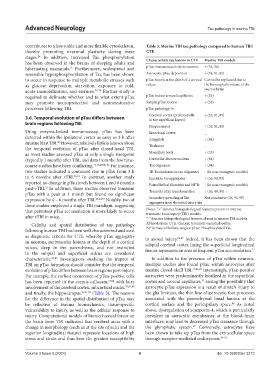
            contributes to a less stable and more flexible cytoskeleton,   Table 3. Murine TBI tau pathology compared to human TBI/
            thereby promoting neuronal plasticity during these   CTE
            stages.  In addition, increased Tau phosphorylation   Characteristic tau lesions in CTE  Murine TBI models
                 24
            has been observed in the brains of sleeping adults and
            hibernating mammals.  Furthermore, widespread and   pTau immunoreactivity in neurons  + (33, 36)
                               75
            reversible hyperphosphorylation of Tau has been shown   Astrocytic pTau deposition  + (33, 81, 85)
            to occur in response to multiple metabolic stresses such   pTau lesions at the depth of a cortical  Cannot be replicated due to
            as glucose deprivation,  starvation, exposure  to cold,   sulcus            the lisencephalic nature of the
            acute immobilization, and seizures. 76-79  Further study is                 murine brain
            required to delineate whether and to what extent pTau   pTau lesions around capillaries  + (33)
            may promote neuroprotective and neurorestorative   Subpial pTau lesions     + (33)
            processes following TBI.                           pTau pathology in
                                                                Cerebral cortex (preferentially    + (33, 81, 85)
            3.6. Temporal evolution of pTau differs between     in the superficial layers)
            brain regions following TBI
                                                                Hippocampus             + (36, 81, 85)
            Using  enzyme-linked  immunoassay,  pTau  has  been   Entorhinal cortex     _
            detected within the ipsilateral cortex as early as 3 h after   Amygdala     + (81)
            murine blast TBI.  However, relatively little is known about   Thalamus     -
                          80
            the temporal evolution of pTau after closed-head TBI,
            as most studies assessed pTau at only a single timepoint   Mamillary body   + (33)
            (typically 1 month) after TBI, and data from the few time-  Cerebellar dentate nucleus  + (81)
            course studies have been conflicting. 33,36,49,80-82  For instance,   Tau oligomers  + (94)
            two studies indicated a continued rise in pTau from 3 h   3R Tau isoforms in tau oligomers  - (In non-transgenic models)
            to 6  months after rTBI. 36,81  In contrast, another study   Insoluble tau aggregates  + (36, 94, 95)
            reported no change in pTau levels between 1 and 6 months   Paired helical filaments and NFTs  - (In non-transgenic models)
            post-rTBI.  In addition, three studies observed transient   Trans/cis pTau transformation  + (36, 49, 50) +
                    33
            pTau with a peak at 1  month but found no significant
            expression by 4 – 6 months after TBI. 49,60,73  Notably, two of   Secondary spreading of Tau   Not conclusive (36, 93-95)
                                                                aggregates from the initial injury site
            these studies employed a single TBI paradigm, suggesting
            that persistent pTau accumulation is more likely to occur   Notes: “+” denotes histopathological features present in murine
                                                               traumatic brain injury (TBI) models.
            after rTBI in mice.                                “-” denotes histopathological features absent in murine TBI models.
              Cellular and spatial distribution of tau pathology   Abbreviations: CTE: Chronic traumatic encephalopathy;
            following human TBI has been well characterized and used   NFTs: Neurofibrillary tangles: pTau: Phosphorylated Tau.
            as diagnostic criteria for CTE, whereby pTau aggregates   to axonal injury. 86,87  Indeed, it has been shown that the
            in neurons, perivascular lesions at the depth of a cortical   subpial cerebral cortex lining the superficial longitudinal
            sulcus,  deep  in  the  parenchyma,  and  not  restricted   fissure represents an area of frequent pTau accumulation. 33
            to the subpial and superficial sulcus are considered
            characteristic. 27,83  Investigators studying the impact of   In addition to the presence of pTau within neurons,
            TBI on pTau formation should consider that the temporal   multiple studies also found pTau within astrocytes after
            evolution of pTau differs between brain regions post-injury.   murine closed-skull TBI. 33,81,85  Interestingly, pTau-positive
            For example, the earliest occurrence of pTau-positive cells   astrocytes were predominantly localized in the superficial
                                                                                       33
            has been reported in the corpus callosum, 33,84  with later   cortex and around capillaries,  raising the possibility that
            involvement of the cerebral cortex, subcortical nuclei, 33,81,85    astrocytic pTau expression is a result of stretch injury to
            and finally, the hippocampus. 36,81,82  (Table 3). The reasons   the glia limitans, the thin line of astrocytic foot processes
            for the difference in the spatial distribution of pTau may   associated with the parenchymal basal lamina at the
            be  reflective  of  trauma  biomechanics,  tissue-specific   cortical surface and the pericapillary space.  As noted
                                                                                                    88
            vulnerability to injury, as well as the cellular response to   above, dysregulation of aquaporin-4, which is particularly
            injury. Computational models of biomechanical forces on   prevalent in astrocytic membranes at the blood–brain
            the brain from TBI indicated that cerebral areas with a   interfaces, may lead to decreased pTau clearance through
                                                                                   69
            change in morphology (such as at the site of sulci and the   the glymphatic system.  Conversely, astrocytes have
            superior longitudinal fissure) represent locations of high   been shown to take up pTau from the extracellular space
            stress and strain and thus bear the greatest susceptibility   through receptor-mediated endocytosis. 89-91


            Volume 3 Issue 3 (2024)                         6                                doi: 10.36922/an.3213

