


Page 30 - AN-3-3
P. 30
Advanced Neurology                                                           Tau pathology in murine TBI


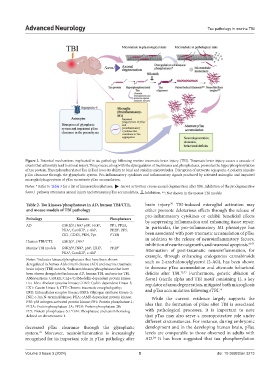
            Figure 2. Potential mechanisms implicated in tau pathology following murine traumatic brain injury (TBI). Traumatic brain injury causes a cascade of
            events that ultimately lead to axonal injury. This process, along with the dysregulation of tau kinases and phosphatases, promotes the hyperphosphorylation
            of tau protein. Hyperphosphorylated Tau (pTau) loses its ability to bind and stabilize microtubules. Disruption of astrocyte aquaporin-4 polarity impairs
            pTau clearance through the glymphatic system. Pro-inflammatory cytokines and inflammatory signals produced by activated microglia and impaired
            microglial phagocytosis of pTau accentuate pTau accumulation.
            Notes: * Refer to Table 3 for a list of kinases/phosphatases,  ►  Sarm1 activation causes axonal degeneration after TBI. Inhibition of the prodegenerative
            Sarm1  pathway attenuates axonal injury and attenuates pTau accumulation,  ┴ :Inhibition, **: Not shown in the mouse TBI models


                                                                         70
            Table 2. Tau kinases/phosphatases in AD, human TBI/CTE,   brain injury.  TBI-induced microglial activation may
            and mouse models of TBI pathology                  either promote deleterious effects through the release of
                                                               pro-inflammatory cytokines or exhibit beneficial effects
            Pathology             Kinases       Phosphatases   by suppressing inflammation and enhancing tissue repair.
            AD             GSK3β , JNK  p38 , ERK ,   PP1, PP2A,   In particular, the pro-inflammatory M1 phenotype has
                                    ‡
                                ‡
                                           †
                                       †
                              †
                                     †
                                                   †
                                         †
                           PKA , CamKII , c-Abl ,   PP2B , PP5,
                           CK1, CDK5, PKN, Fyn  PTEN           been associated with post-traumatic accumulation of pTau
                                ‡
            Human TBI/CTE  GSK3β  , JNK ‡       -              in addition to the release of neuroinflammatory factors,
                                                               inhibition of neurite outgrowth, and neuronal apoptosis.
                                                                                                           60,71
            Murine TBI models  GSK3β , JNK , p38 , ERK ,   PP2B †  Attenuation of post-traumatic neuroinflammation, for
                                            †
                                    ‡
                                ‡
                                       †
                           PKA , CamKII , c-Abl †
                              †
                                     †
                                                               example, through enhancing endogenous cannabinoids
            Notes:  Indicates kinases/phosphatases that have been shown   such as 2-arachidonoylglycerol (2-AG), has been shown
                 †
            deregulated in human Alzheimer’s disease (AD) and murine traumatic
            brain injury (TBI) models,  Indicates kinases/phosphatases that have   to decrease pTau accumulation and attenuate behavioral
                              ‡
            been shown deregulated in human AD, human TBI, and murine TBI.   deficits after TBI. 72,73  Furthermore, genetic ablation of
            Abbreviations: CaMKII: Ca2+/CalModulin-dependent protein kinase   Sarm1 (sterile alpha and TIR motif containing 1), a key
            II; c-Ab: c Abelson tyrosine kinase; CDK5: Cyclin-dependent kinase-5;   regulator of axon degeneration, mitigated both microgliosis
            CK1: Casein kinase 1; CTE: Chronic traumatic encephalopathy;    and pTau accumulation following rTBI. 74
            ERK: Extracellular receptor kinase; GSK3: Glycogen synthase kinase-3;
            JNK: c-Jun N-terminal kinase; PKA: cAMP-dependent protein kinase;   While the current evidence largely supports the
            P38: p38 mitogen-activated protein kinase; PP1: Protein phosphatase-1;   idea that the formation of pTau after TBI is associated
            PP2A: Protein phosphatase-2A; PP2B: Protein phosphatase-2B;
            PP5: Protein phosphatase-5; PTEN: Phosphatase and tensin homolog   with pathological processes, it is important to note
            deleted on chromosome 1.                           that pTau may also serve a neuroprotective role under
                                                               different circumstances. For instance, during embryonic
            decreased pTau clearance through the glymphatic    development and in the developing human brain, pTau
            system.  Moreover, neuroinflammation is increasingly   levels are comparable to those observed in adults with
                  69
            recognized for its important role in pTau pathology after   AD.  It has been suggested that tau phosphorylation
                                                                  24
            Volume 3 Issue 3 (2024)                         5                                doi: 10.36922/an.3213

