


Page 29 - AN-3-3
P. 29
Advanced Neurology                                                           Tau pathology in murine TBI


            modified form of tau protein. There is significant overlap in   3.5. Mechanisms implicated in tau phosphorylation
            the phosphorylation sites of human and mouse tau, and there   following mouse TBI
            are at least 85 distinct identified phosphorylation sites. 30-32    Several lines of data indicate that TBI promotes pTau
            Multiple antibodies recognizing different phosphorylation   formation through deregulating tau kinases including
            sites have been used in the context of closed-head TBI in wild-  c-Jun  N-terminal  kinase  (JNK),  p38  mitogen-activated
            type mice. Among these, the AT8 antibody is most commonly   protein kinase (p38), mitogen-activated protein kinase/
            used,  which  recognizes phosphorylation  at Ser202 and   extracellular signal-regulated kinase (ERK), glycogen
            Thr205.  Other reported antibodies include CP13 (Ser202),    synthase kinase 3b (GSK-3b), protein kinase A (PKA),
                                                         34
                  33
                                                         36
                                  35
            PHF-1 (Ser396 and Ser404),  AT100 (Thr212 and Ser214),    Ca  calmodulin-dependent protein kinase II (CamKII),
                                                                 2+
            AT180 (Thr231), 33,36  anti-Ser262tau, 37,38  anti-Ser413tau,    as well as inhibiting phosphatases (e.g., calcineurin)
                                                         39
            and AT270  (Thr181)  (Figure  1). Using antibodies that   (Figure 2 and Table 2). 35,56-62  Blocking activation of the tau
                             36
            target different phosphorylation sites may provide insight   kinases JNK and GSK-3b, either directly or by inhibiting
            into TBI-specific alterations of tau. For example, antibodies   the adenosine A  receptor (A R), has been shown to
                                                                             2A
                                                                                         2A
            targeting Ser202 and Thr205, as well as Ser396 and Ser404,   reduce cerebral pTau accumulation 39,63,64  and improve
            may detect early phosphorylation events that may be   behavioral outcomes following mouse TBI. 39,63  In addition,
            associated with changes in pTau binding, self-assembly, and   activation  of  the  tyrosine  kinase  c-Abl  promotes  tau
            fibrillar aggregation. 40-47  Conversely, the Tau-66 antibody   oligomerization by phosphorylating tyrosine residues (as
            is thought to recognize pTau epitopes that are only present   detected by T22), which can be inhibited by the blood–
            at later stages of tangle development.  Phosphorylation at   brain barrier penetrating c-Abl inhibitor nilotinib.
                                                                                                            65
                                         48
            Thr231 may indicate a trans-to-cis conformational change   Conversely, TBI has been shown to increase the expression
            tau after TBI, 36,49-52  and the T22 antibody may be specific to   of the calcium-dependent protein phosphatase calcineurin.
            oligomerized tau.  Nevertheless, systematic investigations   Increased calcineurin activity has been linked to neuronal
                          53
            into the ability of different anti-pTau antibodies to detect   dysfunction, whereas attenuation of calcineurin activity
                                                                                                            66
            “early”  versus  “late”  phosphorylation  events  after  TBI  are   preserves synaptic function and plasticity following TBI.
            lacking. The data regarding the overall specificity of various   Interestingly, activated astrocytes express calcineurin and
            anti-pTau antibodies is also conflicting. For example, studies   have been found to contain pTau after TBI. 33,67  However, it
            in tau knockout mice suggest that PHF-1, AT270, and CP13   remains to be demonstrated whether calcineurin activation
            have a higher specificity than AT8 and AT180.  Conversely,   is a driver of astroglial pTau accumulation following TBI. 68
                                                54
            a study using mouse hippocampus and human embryonic   TBI  may also  promote  pTau accumulation through
            kidney (HEK) cells reported that there was an overall high   other mechanisms, such as the upregulation of A R.
                                                                                                          2A
            specificity of AT8, AT180, and PHF-1 but a lower specificity   This upregulation has been shown to disrupt aquaporin-4
            of AT270. 55                                       polarity and increase levels following TBI, suggesting


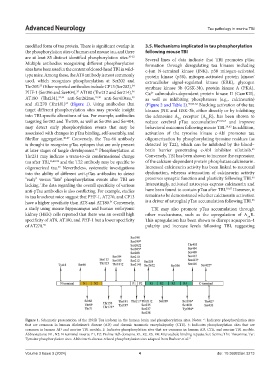
            Figure 1. Schematic presentation of the 2N4R Tau isoform in the human brain and phosphorylation sites. Notes: *: Indicates phosphorylation sites
            that  are  common  in  human  Alzheimer’s  disease  (AD)  and  chronic  traumatic  encephalopathy  (CTE).  †:  Indicates  phosphorylation  sites  that  are
            common in human AD and murine TBI models, ‡: Indicates phosphorylation sites that are common in human AD, CTE, and murine TBI models.
            Abbreviations: N1, N2: N-terminal inserts; P1, P2: Proline rich domains; R1, R2, R3, R4: Microtubule binding repeats; Ser: Serine; Thr: Threonine; Tyr:
            Tyrosine phosphorylation sites. Alzheimer’s disease-related phosphorylation sites adapted from Basheer et al. 31


            Volume 3 Issue 3 (2024)                         4                                doi: 10.36922/an.3213

