


Page 52 - AN-3-3
P. 52
Advanced Neurology                                                     HS-proteoglycans and brain function


            (32kDa) lacks the KPI-3 domain. TFPI functions as an   the HGF activator, thereby inhibiting the conversion of
            anticoagulant protein that blocks the initiation of blood   pro-HGF into its active form.
            coagulation by inhibiting the tissue factor/activated
            factor VIII (TF–fVIIa) complex and thrombin activation.   5.4. Amyloid precursor protein (APP)
            A  study has demonstrated that Tfpi mice die during   The APP contains a KPI domain (protease nexin 2), which
                                           -/-
            embryonic development, displaying stunted brain growth,   acts as a highly specific substrate for mesotrypsin, atypical
            delayed  meningeal  development,  and  severe  vascular   human trypsin implicated in a number of neurodegenerative
                    34
            pathology.  The generation of thrombin is associated with   disorders  (Figure  2A). Neurotrypsin also cleaves agrin
                                                                      36
            hemorrhagic stroke and is central to the pathogenesis of   locally at the synapse. The KPI domain in APP inhibits pro-
            acute ischemic stroke. TFPI-2 exhibits neuroprotective   neuropeptide processing, and the  accumulation of  APP
            properties, inhibits human glioblastoma formation, and   in Aβ plaques may hinder their clearance from tissues,
            inhibits a range of proteases, including plasmin, trypsin,   thereby prolonging their neurotoxic effects in AD and
            chymotrypsin, cathepsin G, plasma kallikrein, FVIIa, Fxa.   PD. The accumulation of Aβ arises from the processing of
            In addition, TFPI-2 inhibits fibrinolysis, thereby regulating   APP-1 by β- and γ-secretases in the brain, an early toxic
            pericellular  proteases  that  are  implicated  in  cancer  cell   event in the pathogenesis of AD that leads to the formation
            invasion, vascular inflammation, and atherosclerosis.   of disruptive intracellular neurofibrillary tangles and
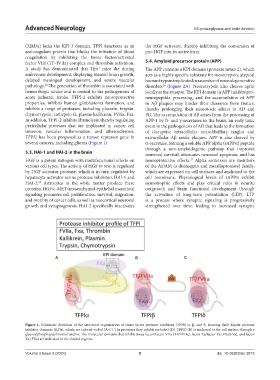
            TFPI2 has been proposed as a tumor repressor gene in   extracellular  Aβ senile plaques. APP  is also  cleaved  by
            several cancers, including glioma (Figure 1).      α-secretase, forming a soluble APP alpha (sAPPα) peptide
                                                               through a non-amyloidogenic pathway that improves
            5.3. HAI-1 and HAI-2 in the brain                  neuronal survival, attenuates neuronal apoptosis, and has
            HGF is a potent mitogen with multifunctional effects on   neuroprotective effects.  Alpha secretases are members
                                                                                  37
            various cell types. The activity of HGF in vivo is regulated   of the ADAM (a disintegrin and metalloprotease) family,
            by HGF activator protease, which is in turn regulated by   which are expressed on cell surfaces and anchored to the
            hepatocyte activator serine protease inhibitors HAI-1 and   cell  membrane. Physiological levels of sAPPα exhibit
            HAI-2.  Astrocytes in the white matter produce these   neurotrophic  effects  and  play  critical  roles  in  neurite
                 35
            proteins. HGF/c-MET (mesenchymal-epithelial transition)   outgrowth and brain functional development through
            signaling promotes cell proliferation, survival, migration,   the activation of long-term potentiation (LTP). LTP
            and motility of cancer cells, as well as neocortical neuronal   is a process where synaptic signaling is progressively
            growth and synaptogenesis. HAI-2 specifically inactivates   strengthened over time, leading to increased synaptic


                         A                                 B                   C


            Figure  1. Schematic depiction of the structural organization of tissue factor protease inhibitors (TFPI)  α,  β, and  δ, showing their Kunitz protease
            inhibitor domains (KPIs), which are colored-coded (A-C). The proteases they inhibit are listed (D). TFPIβ (B) is anchored to the cell surface through a
            glycosylphosphatidylinositol anchor. The molecular domains that inhibit tissue factor/factor VIIa (TF/FVIIa), factor Xa/factor Va (FXa/FVa), and factor
            Xa (FXa) are indicated in the shaded regions.


            Volume 3 Issue 3 (2024)                         5                                doi: 10.36922/an.3812

