


Page 66 - AN-3-3
P. 66
Advanced Neurology                                                            mTOR inhibition in epilepsy


            cognition.  With the emergence and rapid advancement   2. mTOR signaling pathway
                    5
            of genomic technologies, our understanding of epilepsy
            genetics has expanded, revealing critical pathways involved   The mTOR signaling pathway is crucial for regulating
            in epileptogenesis beyond the final common mechanisms   cellular processes such as growth, proliferation, apoptosis,
            of ion channels. This expanded understanding has opened   autophagy, metabolism, and cytoskeletal organization, as
            new avenues for the development of precision medicine.    well as brain-specific functions such as synaptic plasticity,
                                                         6,7
                                                                                                           12-14
            Both dysregulated mammalian or mechanistic targets of   neurogenesis, and dendritic-axonal morphology.
            the rapamycin (mTOR) signaling pathway and heightened   The mTOR protein is a serine-threonine protein kinase
            neuroinflammation have been implicated in epileptogenesis   belonging to the phosphatidylinositol-3-kinase (PI3K)-
            by causing hyperexcitability, altered synaptic transmission,   related protein kinase family. It consists of several domains,
            and increased seizure  susceptibility.  Inhibition of these   such as FAT (FK506-binding proteins [FKBP]-rapamycin-
                                         8
            processes could be a promising therapeutic option with   associated protein [FRAP];  ataxia-telangiectasia mutated
            potential antiepileptogenic or disease-modifying effects. 8  [ATM]; transformation/transcription-domain-associated
                                                               protein; and TRRAP), FKBP 12-rapamycin-binding (FRB),
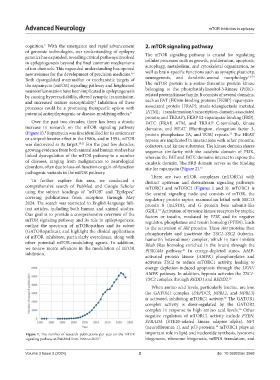
              Over the past two decades, there has been a drastic   FATC  (FRAP,  ATM, and  TRRAP C-terminal),  kinase
            increase in research on the mTOR signaling pathway   domains, and HEAT (Huntington, elongation factor 3,
            (Figure 1).  Rapamycin was first identified for its anticancer   protein phosphatase 2A, and TOR) repeats.  The HEAT
                    9
                                                                                                   13
            or antiproliferative effect in the 1980s, and in 1994, mTOR   repeats are implicated in interactions with other proteins,
            was discovered as its target. 10,11  For the past few decades,   cofactors, and kinase substrates. The kinase domain shares
            growing evidence from both animal and human studies has   sequence similarity with the catalytic domain of PI3K,
            linked dysregulation of the mTOR pathway to a number   whereas the FAT and FATC domains interact to expose the
            of  diseases,  ranging  from malignancies  to neurological   catalytic domain. The FRB domain serves as the binding
            disorders, often due to loss-of-function or gain-of-function   site for rapamycin (Figure 2). 15
            pathogenic variants in the mTOR pathway.
                                                                 There are two mTOR complexes (mTORCs) with
              To further explore this area, we conducted a     distinct upstream and downstream signaling pathways:
            comprehensive search of  PubMed  and  Google  Scholar   mTORC1 and mTORC2 (Figures  2  and  3). mTORC1 is
            using the subject headings of “mTOR” and “Epilepsy,”   the central signaling node and consists of mTOR, the
            covering publications from inception through May   regulatory protein raptor, mammalian lethal with SEC13
            2024. The search was restricted to English-language full-  protein 8 (mLST8), and G protein beta subunit-like
            text articles, including  both human and animal studies.   (GβL).  Activation of tyrosine kinase receptors by trophic
                                                                    16
            Our goal is to provide a comprehensive overview of the   factors or insulin, mediated by  PI3K and its negative
            mTOR signaling pathway and its role in epileptogenesis,   regulator, phosphatase and tensin homolog (PTEN), leads
            outline the spectrum of mTORopathies and its subset   to the activation of Akt proteins. These Akt proteins then
            (GATORopathies), and highlight the clinical applications   phosphorylate and inactivate the  TSC1-TSC2 (tuberin-
            of mTOR inhibitors, particularly everolimus, along with   hamartin heterodimer) complex, which in turn inhibits
            other potential mTOR-modulating agents. In addition,   Rheb (Ras homolog enriched in the brain) through the
            we review recent advances in the modulation of mTOR   PI3K/Akt pathway.  In energy-depleted states, AMP-
                                                                               16
            inhibition.                                        activated protein kinase (AMPK) phosphorylates and
                                                               activates  TSC2  to  reduce  mTORC1  activity,  leading  to
                                                               energy depletion-induced apoptosis through the  LKB1/
                                                               AMPK pathway. In addition, hypoxia activates the TSC1-
                                                               TSC2 complex through REDD1 and REDD2. 16

                                                                 When amino acid levels, particularly leucine, are low,
                                                               the GATOR1 complex (DEPDC5, NPRL2,  and  NPRL3)
                                                               is activated, inhibiting mTORC1 activity.  The GATOR1
                                                                                                16
                                                               complex activity is downregulated by the GATOR2
                                                               complex in response to high amino acid levels.  Other
                                                                                                       16
                                                               negative regulators of mTORC1 activity include  PTEN,
                                                               STRADA (STE20-related kinase adaptor alpha),  NF1
                                                               (neurofibromin 1), and p53 proteins.  mTORC1 plays an
                                                                                             16
            Figure 1. The number of research publications per year on the mTOR   important role in lipid and nucleotide synthesis, lysosome
            signaling pathway in PubMed from 1986 to 2023. 9   biogenesis, ribosome biogenesis, mRNA translation, and


            Volume 3 Issue 3 (2024)                         2                                doi: 10.36922/an.3568

