


Page 79 - AN-4-1
P. 79
Advanced Neurology                                                       The South London Stroke Register


              We describe the challenges of running a population-  over time, in line with changing clinical pathways and
            based  stroke  register,  its  key  findings  and  its  impact  on   diagnostic procedures. In earlier years, notifications
            the delivery of effective stroke care locally, nationally and   included community-  and primary care-based sources,
            internationally.                                   such as general practitioners, community therapists and
                                                               coroners. Now, in the UK, all patients with stroke or TIA
            2. Recruitment and follow-up – and its             symptoms are expected to undergo brain imaging and be
            changes and challenges over time                   referred to specialist hospital services. Case ascertainment
            London as a location for a population-based register   has therefore shifted further towards hospital-based
            brings distinct advantages. The SLSR study area comprises   sources. Apart from hospitals within the study area, those
            a geographic area of South London (defined by electoral   neighbouring  the  study  area  have  been  established  as
            wards) with a multi-ethnic population and areas of   secondary recruitment sites to ensure outlying patients are
            significant deprivation. Its study population grew from   included.
            234,533 in 1996 (72% White ethnic group)  to 398,555 in   Running the SLSR involves multiple logistical challenges,
                                              3
            2021, while becoming ethnically highly diverse (52% White   including  conducting  detailed  follow-up  interviews,  in
            ethnic group, 25% Black ethnic group, 23% from other   some years with over 1300 participants. The majority of
            ethnic backgrounds)  and neighbourhoods on average less   follow-ups were conducted face-to-face, through time-
                            4
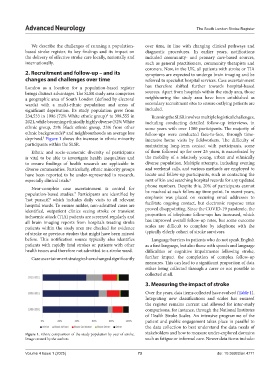
            deprived.  Figure 1 shows the increase in ethnic minority   intensive home visits by fieldworkers. The difficulty of
                   5
            participants within the SLSR.                      maintaining long-term contact with participants, some
              Ethnic and socio-economic diversity of participants   of them followed up for over 25 years, is exacerbated by
            is vital to be able to investigate health inequalities and   the mobility of a relatively young, urban and ethnically
            to ensure findings of health research are applicable in   diverse population. Multiple attempts, including evening
            diverse communities. Particularly, ethnic minority groups   and weekend calls, and various methods are employed to
            have been reported to be under-represented in research,   locate and follow-up participants, such as contacting the
            especially clinical trials. 6                      next of kin and searching hospital records for any updated
                                                               phone numbers. Despite this, 20% of participants cannot
              Near-complete case ascertainment is central for
            population-based studies.  Participants are identified by   be reached at each follow-up time point. In recent years,
                                 7
            ‘hot pursuit’,  which includes daily visits to all relevant   emphasis was placed on securing email addresses to
                      8
            hospital wards. To ensure milder, non-admitted cases are   facilitate ongoing contact, but electronic response rates
            identified, outpatient clinics seeing stroke or transient   proved disappointing. Since the COVID-19 pandemic, the
            ischaemic attack (TIA) patients are screened regularly and   proportion of telephone follow-ups has increased, which
            all brain imaging reports from hospitals treating stroke   has improved overall follow-up rates, but some outcome
            patients within the study area are checked for evidence   scales are difficult to complete by telephone with the
            of stroke or previous strokes that might have been missed   typically elderly cohort of stroke survivors.
            before.  This notification source typically also identifies   Language barriers in patients who do not speak English
            patients with rapidly fatal strokes or patients with other   as a first language, but also those with speech and language
            health issues and therefore not admitted to a stroke ward.  difficulties or cognitive impairments following stroke,
              Case ascertainment strategies have changed significantly   further impact the completion of complex follow-up
                                                               measures. This can lead to a significant proportion of data
                                                               either being collected through a carer or not possible to
                                                               collected at all.
                                                               3. Measuring the impact of stroke

                                                               Over the years, data items collected have evolved (Table 1).
                                                               Integrating new classifications and scales has ensured
                                                               the register remains current and allowed for inter-study
                                                               comparisons, for instance, through the National Institutes
                                                               of Health Stroke Scales. An intensive programme of the
                                                               patient and public engagement takes place in parallel to
                                                               the data collection to best understand the data needs of
            Figure 1. Ethnic composition of the study population by year of stroke.   stakeholders and how to measure under-explored domains
            Image created by the authors.                      such as fatigue or informal care. Newer data items include:


            Volume 4 Issue 1 (2025)                         73                               doi: 10.36922/an.4771

