


Page 86 - AN-4-4
P. 86
Advanced Neurology                                                   Cytokine response to EV therapy in SCI


            MSC-EVs was applied immediately after injury (SCI FM   2.5. Statistical analysis
            group: n = 6). In the two experimental groups, 5 and 10 µg   Data  were  analyzed  using  the  Origin  Pro  software
                                                         ®
            of MSC-EVs encapsulated in 18  µl of FM (Tissucol ;   (version  2020 [9.7], OriginLab Corp., USA). Data are
            Baxter, USA) were applied immediately after injury (SCI   presented as mean values with standard deviation (SD) or
            FM+EVs5 group: n = 6; SCI FM+EVs10 group: n = 5). After   standard error (SE). A normality test was conducted for
            surgery, all rats received daily intramuscular gentamicin   all study groups. One-way analysis of variance (ANOVA)
            (25  mg/kg; Microgen, Russia) for 7  days. Bladders of   followed by Tukey’s test was performed for multiple group
            the injured rats were manually emptied twice daily until   comparisons.  All  analyses  were  performed  in  a  blinded
            spontaneous urination was restored.                manner relative to the study groups. A value of p<0.05 was
            2.4. Multiplex assay                               considered statistically significant.
            To assess the cytokine profiles at 60-day post-injury (dpi),   3. Results
            a section of the spinal cord, including the injury epicenter,   Cytokine levels in spinal cord homogenates from the four
            was dissected at the Th8 level. The tissue was homogenized   groups (SCI, SCI FM, SCI FM+EVs5, and SCI FM+EVs10)
            using an electric homogenizer in 300  µL of complete   at 60 dpi revealed notable differences in the expression
            extraction buffer. Following centrifugation at 13,000 rpm   patterns. The data obtained through multiplex analysis
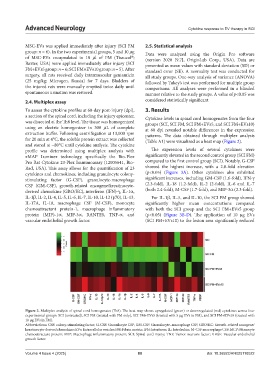
            for 20 min at 4°C, the soluble protein extract was collected   (Table A1) were visualized as a heat map (Figure 2).
            and stored at −80°C until cytokine analysis. The cytokine
            profile was determined using multiplex analysis with   The expression levels of several cytokines were
            xMAP Luminex technology, specifically the Bio-Plex   significantly elevated in the second control group (SCI FM)
            Pro Rat Cytokine 23-Plex Immunoassay (12005641, Bio-  compared to the first control group (SCI). Notably, G-CSF
            Rad, USA). This assay allows for the quantification of 23   showed the highest increase, with a 2.8-fold elevation
            cytokines and chemokines, including granulocyte colony-  (p<0.05) (Figure  3A). Other cytokines also exhibited
            stimulating  factor  (G-CSF),  granulocyte-macrophage   significant increases, including GM-CSF (1.6-fold), IFN-γ
            CSF  (GM-CSF),  growth-related  oncogene/keratinocyte-  (2.3-fold), IL-18  (1.2-fold), IL-2  (2-fold), IL-6 and IL-7
            derived chemokine (GRO/KC), interferon (IFN)-γ, IL-1α,   (both 2.4-fold), M-CSF (1.7-fold), and MIP-3α (2.3-fold).
            IL-1β, IL-2, IL-4, IL-5, IL-6, IL-7, IL-10, IL-12 (p70), IL-13,   For IL-1β, IL-5, and IL-10, the SCI FM group showed
            IL-17A, IL-18, macrophage CSF (M-CSF), monocyte    significantly higher mean concentrations compared
            chemoattractant protein-1, macrophage inflammatory   with both the SCI group and the SCI FM+EVs5 group
            protein (MIP)-1α, MIP-3α, RANTES, TNF-α, and       (p<0.05) (Figure  3B-D). The application of 10  µg EVs
            vascular endothelial growth factor.                (SCI FM+EVs10) to the lesion area significantly reduced


            Figure 2. Multiplex analysis of spinal cord homogenates (Th8). The heat map shows upregulated (green) or downregulated (red) cytokines across four
            experimental groups: SCI (untreated), SCI FM (treated with FM only), SCI FM+EVs5 (treated with 5 µg EVs in FM), and SCI FM+EVs10 (treated with
            10 µg EVs in FM).
            Abbreviations: CSF: colony-stimulating factor; G-CSF: Granulocyte CSF; GM-CSF: Granulocyte–macrophage CSF; GRO/KC: Growth-related oncogene/
            keratinocyte-derived chemokine; EVs: Extracellular vesicles; FM: Fibrin matrix; IFN: Interferon; IL: Interleukin; M-CSF: macrophage CSF; MCP: Monocyte
            chemoattractant protein; MIP: Macrophage inflammatory protein; SCI: Spinal cord injury; TNF: Tumor necrosis factor; VEGF: Vascular endothelial
            growth factor.


            Volume 4 Issue 4 (2025)                         80                           doi: 10.36922/AN025110022

