


Page 16 - ARNM-1-1
P. 16
Advances in Radiotherapy
            & Nuclear Medicine                                                Seed implantation head-and-neck carcinoma


            region. The recurrence site location varies, resulting in
            differences in anesthesia style, set-up position, and template
            model.
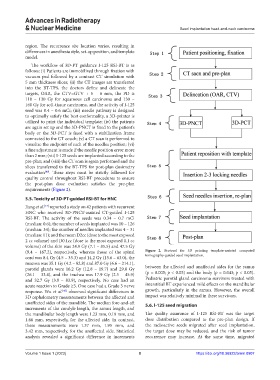
              The workflow of 3D-PT guidance I-125 RSI-BT is as
            follows: (i) Patients are immobilized through fixation with
            vacuum pad followed by a contrast CT simulation with
            5 mm thickness slices; (ii) the CT images are transferred
            into the BT-TPS, the doctors define and delineate the
            targets, OAR, the CTV=GTV + 5 − 6  mm, the PD is
            110 – 130  Gy for squamous cell carcinoma and 130 –
            160 Gy for soft-tissue carcinoma, and the activity of I-125
            seed was 0.4 – 0.6 mCi; (iii) needle pathway is designed
            to optimally satisfy the best conformality, a 3D-printer is
            utilized to print the individual template; (iv) the patients
            are again set up and the 3D-PNCT is fixed to the patient’s
            body or  the 3D-PCT  is fixed with  a stabilization frame
            connected to the CT couch; (v) a CT scan is performed to
            visualize the endpoint of each of the needles position; (vi)
            a fine adjustment is made if the needle position error more
            than 2 mm; (vii) I-125 seeds are implanted according to the
            pre-plan; and (viii) the CT scan is again performed and the
            slices transferred to the BT-TPS for post-plan dosimetry
            evaluation . These steps must be strictly followed for
                    [40]
            quality control throughout RSI-BT procedures to ensure
            the  post-plan  dose  evaluation  satisfies  the  pre-plan
            requirements (Figure 2).
            5.5. Toxicity of 3D-PT-guided RSI-BT for HNC
            Jiang et al.  reported a study on 42 patients with recurrent
                    [17]
            HNC who received 3D-PNCT-assisted CT-guided I-125
            RSI-BT. The activity of the seeds was 0.34 – 0.7 mCi
            (median: 0.6); the number of seeds implanted was 10 – 126
            (median: 34); the number of needles implanted was 4 – 31
            (median: 11); and the mean D2cc (dose to the most exposed
            2 cc volume) and D0.1cc (dose to the most exposed 0.1 cc
            volume) of the skin was 24.9 Gy (7.1 – 85.5) and 47.5 Gy
            (9.4 – 167.2), respectively, whereas those of the spinal   Figure  2. Protocol for 3D printing template-assisted computed
            cord was 8.4 Gy (4.5 – 33.3) and 14.2 Gy (13.6 – 63.0), the   tomography-guided seed implantation.
            mucosa was 35.1 Gy (4.2 – 82.8) and 87.0 Gy (6.6 – 214.1),
            parotid glands were 16.2  Gy (12.8 – 19.7) and 29.8  Gy   between the affected and unaffected sides for the ramus
            (26.1  –  33.4),  and  the  trachea  was  17.9  Gy  (2.5  –  45.9)   (p = 0.005; p < 0.05) and the body (p = 0.043; p < 0.05).
            and 32.7  Gy (3.9 – 83.9), respectively. No case had an   Pediatric parotid gland carcinoma survivors treated with
            acute reaction to Grade ≥3. One case had a Grade 3 nerve   interstitial BT experienced mild effects on the mandibular
            response. Wu et al.  observed significant differences in   growth, particularly in the ramus. However, the overall
                            [43]
            3D cephalometry measurements between the affected and   impact was relatively minimal in these survivors.
            unaffected sides of the mandible. The median fore-and-aft   5.6. I-125 seed migration
            increments of the condyle length, the ramus length, and
            the mandibular body length were 1.23 mm, 0.19 mm, and   The quality assurance of I-125 RSI-BT was the target
            1.66  mm, respectively, for the affected side. In contrast,   dose distribution compared to the pre-plan design. If
            these measurements were 1.37  mm, 1.95  mm, and    the radioactive seeds migrated after seed implantation,
            3.42 mm, respectively, for the unaffected side. Statistical   the target dose may be reduced, and the risk of tumor
            analysis  revealed  a significant  difference  in increments   recurrence may increase. At the same time, migrated


            Volume 1 Issue 1 (2023)                         8                       https://doi.org/10.36922/arnm.0907

