


Page 13 - ARNM-1-1
P. 13
Advances in Radiotherapy
            & Nuclear Medicine                                                Seed implantation head-and-neck carcinoma


            and 5-year OS rates were 63.6%, 44.6%, 29.9%, and 21.7%,   The disadvantages of CT-guidance for I-125 RSI-BT
            respectively, with a median OS of 20.0 months. The study   are as follows: (i) the long process to train a skilled
            reported skin and mucosal toxicities as the major adverse   interventional doctor; (ii) the needles’ distribution
            events, with the major being lower grade (Grade 2). These   that cannot be followed as designed in the pre-plan
            adverse events were generally well tolerated by the patients.   with free-hand performance due to organ movement,
            CT guidance for RSI-BT was an optimal salvage treatment   changes  and distortions in tumor shape, bleeding, and
            not only for advanced parotid gland carcinoma but also   interference with the OAR such as blood vessels and
            for rHNC, which showed a promising prognosis and lower   boney anatomy; (iii) the non-satisfactory quality control
            toxicity. However, the quality assurance in the target dose   of RSI-BT according to post-plan dose evaluation; (iv) the
            pattern was still suboptimal, which cannot realize the pre-  different locations where the operation and CT scan take
            plan designed requirements, resulting in various outcomes.   place; (v) the increase in patient’s radiation exposure due
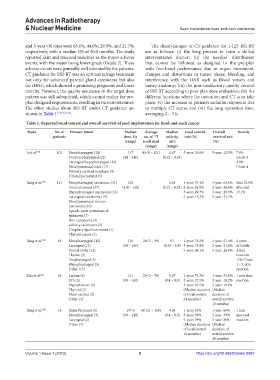
            The other studies about RSI-BT under CT guidance are   to multiple CT scans; and (vi) the long operation time,
            shown in Table 1 [14,16,31,32] .                   averaging 2 – 3 h.

            Table 1. Reported local control and overall survival of seed implantation for head-and-neck cancer
             Study      No. of   Primary tumor        Median   Average   Median   Local control   Overall   Toxicity
                                                                  125
                        patients                      dose, Gy   no. of  I   activity,   rate (%)  survival rate
                                                      (range)  seeds used   mCi             (%)
                                                               (range)  (range)
            Ji et al. [14]  101  Nasopharyngeal (28)   117    43 (8 – 121)  0.67    5-year: 26.6%  5-year: 15.5% 7.9%
                              Oral/oropharyngeal (22)  (44 – 246)     (0.22 – 0.83)                  Grade 3
                              Laryngeal/hypopharyngeal (22)                                          2.0%
                              Nasal/paranasal sinus (17)                                             Grade 4
                              Primary cervical neoplasm (9)
                              Orbital/periorbital (3)
            Jiang et al. [16]  113  Nasopharyngeal carcinoma (31)  120    -  0.65    1-year: 57.4%  1-year: 63.6% Skin 22.9%
                              Oral carcinoma (27)    (110 – 160)      (0.22 – 0.83) 2-year: 41.8%  2-year: 44.6% Mucosal
                              Hypopharyngeal carcinoma (16)                    3-year: 29.3%  3-year: 29.9% 15.1%
                              Laryngeal carcinoma (15)                         5-year: 15.2%  5-year: 21.7%
                              Nasal/pararnasal sinuses
                              carcinoma (10)
                              Lymph-node metastasis of
                              unknown (7)
                              Skin carcinoma (3)
                              salivary carcinoma (2)
                              Oropharyngeal carcinoma (1)
                              Thyroid cancer (1)
            Jiang et al. [13]  64  Nasopharyngeal (12)  130    20 (3 – 89)  0.7    1-year: 75.2%  1-year: 57.4% 2 cases
                              Laryngeal (12)         (90 – 160)        (0.35 – 0.8) 3-year: 73.0%  3-year: 31.0% of Grade
                              Buccal cavity (12)                               5-year: 69.1%  5-year: 26.6% 4 skin
                              Thymic (5)                                                             reaction;
                              Oropharyngeal (5)                                                      17% Grade
                              Hypopharyngeal (5)                                                     1 – 2 skin
                              Other (13)                                                             reaction
            Zhu et al. [31]  19  Larynx (6)            131    29 (3 – 78)  0.67    1-year: 73.3%  1-year: 53.0% 1 case skin
                              STS (3)                (90 – 160)        (0.4 – 0.8) 2-year: 27.5%  2-year: 18.2% reaction
                              Hypopharynx (2)                                  3-year: 27.5%   3-year: 18.2%
                              Thyroid (2)                                      (Median duration  (Median
                              Nasal cavities (2)                               of local control:   duration of
                              Other (4)                                        24 months)  overall survive:
                                                                                           13 months)
            Jiang et al. [32]  14  Sinus Paranasal (5)  157.5    48 (21 – 158)  0.65    1-year: 52%  1-year: 65%  1 case
                              Nasopharyngeal (3)     (90 – 218)        (0.4 – 0.8) 3-year: 39%  3-year: 39%  mucosal
                              Laryngeal (2)                                    5-year: 39%   5-year: 39%   reaction
                              Other (4)                                        (Median duration  (Median
                                                                               of local control:   duration of
                                                                               18 months)  overall survive:
                                                                                           20 months)


            Volume 1 Issue 1 (2023)                         5                       https://doi.org/10.36922/arnm.0907

