


Page 18 - ARNM-1-1
P. 18
Advances in Radiotherapy
            & Nuclear Medicine                                                Seed implantation head-and-neck carcinoma


            The distribution of I-125 seeds in the target is generally   and position to satisfy the target’s dose conformity and
            implanted according to a pattern of modified peripheral   avoid the OARs.
            loading. The needle’s position in BT-TPS for prostate
            carcinoma is typically horizontal for all the needles’   7.2. Pre-plan, real-time plan, and post-plan
            arrangement and kept parallelly by plane template    The pre-plan is very important for I-125 RSI-BT. The
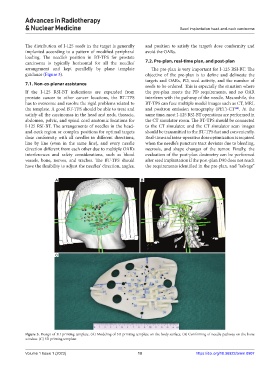
            guidance (Figure 3).                               objective of the pre-plan is to define and delineate the
                                                               targets and OARs, PD, seed activity, and the number of
            7.1. Non-co-planar assistance
                                                               seeds to be ordered. This is especially the situation where
            If  the  I-125  RSI-BT  indications  are  expanded  from   the pre-plan meets the PD requirements, and no OAR
            prostate cancer to other cancer locations, the BT-TPS   interferes with the pathway of the needle. Meanwhile, the
            has to overcome and resolve the rigid problems related to   BT-TPS can fuse multiple model images such as CT, MRI,
            the template. A good BT-TPS should be able to treat and   and positron emission tomography (PET)-CT . At the
                                                                                                     [48]
            satisfy all the carcinomas in the head and neck, thoracic,   same time, most I-125 RSI-BT operations are performed in
            abdomen, pelvic, and spinal cord anatomic locations for   the CT simulator room. The BT-TPS should be connected
            I-125 RSI-BT. The arrangements of needles in the head-  to the CT simulator, and the CT simulator scan images
            and-neck region or complex positions for optimal targets   should be transmitted to the BT-TPS fast and conveniently.
            dose conformity with all needles in different directions,   Real-time and intra-operative dose optimization is required
            line by line (even in the same line), and every needle   when the needle’s puncture tract deviates due to bleeding,
            direction different from each other due to multiple OAR’s   necrosis, and shape changes of the tumor. Finally, the
            interferences and safety considerations, such as blood   evaluation of the post-plan dosimetry can be performed
            vessels, bone, nerves, and trachea. The BT-TPS should   after seed implantation if the post-plan D90 does not reach
            have the flexibility to adjust the needles’ direction, angles,   the requirements identified in the pre-plan, and “salvage”


                         A                                   B


                         C


            Figure 3. Design of 3D printing template. (A) Modeling of 3D printing template on the body surface. (B) Confirming of needle pathway on the bone
            window. (C) 3D printing template.


            Volume 1 Issue 1 (2023)                         10                      https://doi.org/10.36922/arnm.0907

